
Assess your first aid requirements
To meet your first aid responsibilities as an employer, you first need to complete a written first aid assessment for each of your workplaces. Different workplaces may have different first aid requirements.
If your workplace has a joint health and safety committee or a worker health and safety representative, you must involve them in the assessment process.
If you are the prime contractor for a multiple-employer workplace, you must conduct a first aid assessment for that workplace.
Follow the steps below to complete your assessment.

Knowledge required
You need a complete understanding of your workplace(s) and the number of workers on site at different times. You do not need specialized first aid knowledge to complete your assessment.
What you need
First aid assessment tool or First aid assessment worksheet (optional)
To conduct a first aid assessment
-
1
Identify each workplace
A workplace is any place where a worker is likely to be engaged in work. This includes vehicles and mobile equipment used by a worker while they are working.
-
2
Determine the maximum number of workers at each workplace
This includes full-time and part-time employees, administrative staff, managers, and supervisors. It also includes dispatch, shift, and transient workers.
-
3
Find your hazard rating for each workplace and review it
Find your WorkSafeBC hazard rating. You can find your WorkSafeBC hazard rating by using the link below, or on the assessment rate letter that WorkSafeBC sends you every year. The hazard rating is in the classification unit description area of that letter.
Review your assigned hazard rating. There are some workplace situations that may allow or require you to use a different hazard rating than the default rating assigned to you.
-
4
Determine how easy it is for ambulance attendants to get to your workplace
To do this, you need to know if your workplace is remote, less accessible, or both, as defined in the OHS Regulation. A workplace is considered remote if it takes an ambulance more than 30 minutes to get to your location under normal travel conditions. A workplace is considered less accessible when work areas cannot be safely accessed by ambulance attendants.
-
5
Think about other barriers to first aid
A barrier is anything that could potentially limit or delay a worker's access to first aid. When conducting your assessment, you must consider and address all barriers to first aid in each of your workplaces.
-
6
Know your required first aid supplies and services for each workplace
After you gather information from each of the steps above, you can determine the specific first aid requirements for your workplace or workplaces. This includes first aid kits and equipment, first aid facilities, first aid attendants, and emergency transportation provisions.
-
7
Document your assessment
In your written first aid assessment, write down the first aid supplies and services you need to have available at each workplace. This includes first aid kits and equipment, facilities, first aid attendants, and emergency transportation provisions.
-
8
Review your first aid assessment annually or when changes occur
To make sure it stays accurate, you must review your first aid assessment every 12 months or whenever something changes at your workplace that could impact first aid requirements.
Related resources
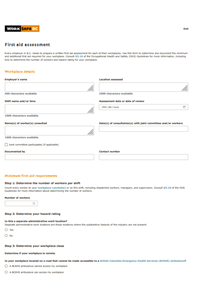
First aid assessment
If you are an employer, you need to do a written assessment to determine the first aid equipment, supplies, and facilities required at each of your workplaces. This interactive online tool is provided...
Title
Please note: The content on this page is intended to help you understand and meet the requirements of the Occupational Health and Safety Regulation. More detailed information can be found in the OHS Guidelines and/or OHS Regulation.