
Turning safety into a habit for young workers
Published on: September 4, 2026
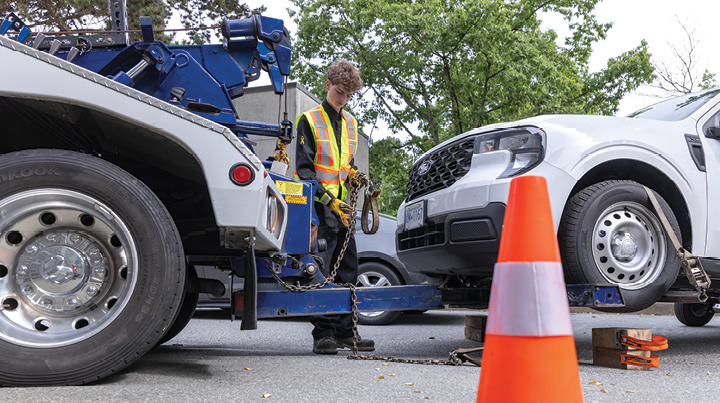
Safe work habits don’t develop overnight. For 18-year-old tow operator Greyson Martin, they were built through training, hands-on experience, and support.
By Sarah Ripplinger
Even with years spent around the towing industry, Greyson still had plenty to learn when he entered the trade. The support and encouragement he received helped him build skills, gain confidence, and eventually mentor other young workers.
As the owner’s son, Greyson grew up around Mitchell’s Towing. By age 12, he was helping on some tow jobs and was later involved with the company’s salvage program. At 16, he rode along in one of the company’s flatbed trucks “to get a feel for the job and see if I actually wanted to do it and pursue training.”
These early experiences set him up for success. He went on to complete multiple WreckMaster certifications, earn an air brake endorsement, and train on rotator trucks. He was also one of the youngest tow operators to receive specialized rigging training through the U.S. Occupational Safety and Health Administration (OSHA).
But his biggest lessons came after he joined Mitchell’s Towing full-time in 2025.
Build safe habits from the start
Towing is a high-risk job, especially for young workers.
“Young workers often look to their supervisors for guidance, which gives employers an important opportunity to reinforce safe habits,” says Robin Schooley, a WorkSafeBC industry and program specialist.
WorkSafeBC’s research shows that when employers prioritize safety, workers are more likely to do the same, says Schooley.
“The safety habits young workers develop early on can shape how they work for the rest of their careers.”
Reinforce learning on the job
During his first weeks at Mitchell’s, Greyson shadowed an experienced tow operator. He then began performing vehicle recoveries under supervision before taking calls on his own.
“With the orientation, you get to know the driver and kind of become buddies with them,” he says. “That made me feel more comfortable calling them if I needed help.”
Training and mentoring tailored to a young worker’s experience level and the task at hand build judgment, encourage questions, and support a safe workplace. Under the Occupational Health and Safety Regulation, employers must provide young and new workers with orientation, training, and supervision. Workers also have the right to request more training when they need it.
“Employers should set clear checkpoints before a young worker takes on more complex work. This includes making sure they understand what they’ve learned and can apply those skills on the job,” notes Schooley. “Young workers also need regular check-ins, refreshers, new information, and on-call support as they take on more complex tasks.”
Learning continues after orientation
Despite all of his training and preparation, Greyson quickly learned that not every situation can be planned for.
“I was using a wrecker tow truck to load a vehicle with a flat tire,” recalls Greyson. “All four wheels had to be lifted off the ground, so I needed to use a dolly system and slide two metal rails under the rear wheels.”
But the vehicle was angled on a curb, so the dolly approach wouldn’t work.
“I got my manager on a video call, and he talked me through a couple of ways to get the vehicle onto the dolly safely,” he says. “It showed me how complex this job can be.”
The experience reinforced an important lesson: knowing when to ask for help can be just as important as knowing how to do the work itself.
Turn questions into a safety habit
Employers and supervisors should encourage young workers to ask questions and seek feedback when they need help, says Schooley.
“Take time to ask young workers what they found challenging that day or whether there’s anything that they need help with,” Schooley suggests. “When done in a genuine way, regular check-ins can help break down barriers, build trust, and turn speaking up into a habit.”
Knowing support is only a phone or video call away has helped Greyson build confidence as he grows in his career. It has also inspired him to support other young workers joining the team.
“I’ve encouraged other young people starting off with the company to speak up and call us any time they need help, because we’ll be there,” he says. “If they need me, I’ll drive out to help them at 2 a.m. They’re never alone.”
Training and experience helped Greyson develop his skills, but support helped turn safety into a habit. Today, he encourages other young workers to build that habit from the start.
Employers make a lasting difference
By fostering a positive workplace culture where questions are encouraged and support is always available, employers can help young workers build the skills, confidence, and safe work habits that support a long and successful career.
Find out more
Visit worksafebc.com to learn more about young and new workers.
This article originally appeared in the Fall 2026 issue of WorkSafe Magazine.
To read more or to subscribe, visit WorkSafe Magazine.
More in this issue
- Ask an officer: Training and orienting new and young workers
- Setting up for success with small tools training
- Towing safety beyond the shoulder
- Stitching safety into every step
- Building respectful workplaces in tourism and hospitality
- Preparing for regulatory updates
- Making it easier to connect with us