
Stitching safety into every step
Published on: September 4, 2026
This small leather maker’s outstanding safety record shows how thoughtful onboarding, hands-on training, and daily controls can reduce injury risks and engage employees in workplace safety.
By Marguerite Pigeon
A handmade leather belt or wallet reflects the skill and craft that goes into making it. But for leather workers, skilled tasks such as cutting, sewing, finishing, and branding products can also create injury risks.
Stitching leather with thick needles can strain hands and fingers. Standing for prolonged periods while dyeing and waxing leather — the process of finishing the cut edges of a belt or wallet — can lead to fatigue. Using heat presses to brand leather can cause burns.
That’s why, for one small B.C. leather products maker, safety is a top priority. Over the past 13 years, Popov Leather, located in Nelson, B.C., has made onboarding, training, and participation central to its health and safety program.
The company has grown from a husband-and-wife operation to a team of 21 employees. In 2025, it sold 51,000 leather goods while maintaining a zero-injury-claim record over the past decade.
Starting before day one
At Popov, attention to safety starts even before a worker’s first day on the job. The company looks for people who are eager to learn, ask questions, and add to Popov’s safety culture, explains Stacy McCuaig, product development manager. That means hiring people who are willing to speak up about concerns and share new ideas.
It also values people from a variety of work backgrounds and experiences. “What they’re bringing from their past makes us better,” she says. Those perspectives can lead to solutions that improve both safety and production.
Orienting for safety
On day one, new hires get a hands-on orientation. “We do a full overview of our safety program and everything in the shop,” says Reese Williamson, Popov’s workshop manager.
Williamson has helped onboard more than 20 workers in the past 3 years alone, thanks to a rapidly growing demand for Popov’s products. He ensures all new workers understand the safety risks of leather work and encourages them to ask questions.
For M. Peters, an occupational safety officer with WorkSafeBC, Popov’s proactive approach to prevention stands out. He says the company’s orientation builds safe habits into everyday work. “It sends the message that safety is an expectation and a core value of work every day.”
Building skills safely
Next comes training. Workers usually start with sewing because it can take up to two weeks to build that skill, says Williamson. During this time, it’s the company’s turn to ask questions.
“When we train staff, we ask, ‘How does this task feel? Is anything about it awkward or difficult?’ We encourage everyone to speak up if something feels uncomfortable so we can find better or safer ways of doing the work.”
For heavy machine training, Popov uses an employee training matrix. That means a senior employee documents training and confirms it’s complete before a new worker can run a machine. The company has also invested in two-button machinery, which requires the employee to use both hands to activate the controls. This helps reduce the risk of injuries from being caught in the machinery.
Rotating tasks
One distinctive feature at Popov is that employees are trained in every task involved in making the company’s products. Workers rotate every four hours, moving between standing and sitting, and between workstations. In a single shift, a worker can move between several tasks, from sewing to waxing.
Peters says task rotation is an effective administrative control. When workers alternate between tasks that use different muscle groups, it allows muscles time to rest and recover. This reduces repetitive strain. Popov’s approach shows that even simple ideas can lead to meaningful safety improvements.
Listening and sharing
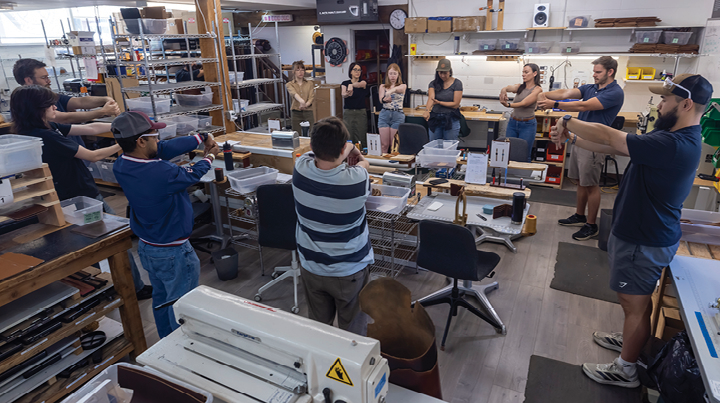
At 10 a.m. each day, Popov employees gather for their stand-up. That’s a meeting where managers discuss safety updates, production goals, and ideas for improvement. It’s also a time to share. “It serves as an open forum for anybody to talk about their ideas for improvement,” says McCuaig.
Both McCuaig and Williamson agree daily meetings help support employees while boosting camaraderie. The meetings include group stretches and staff take turns choosing the music playlist.
Creating a safer workplace
Ongoing discussions and feedback have led Popov to bring in new safety controls, like height-adjustable tables. Each table has a clamp that holds the leather in place, freeing up hands for stitching and lacing. The shop is also fitted with a large filter to reduce the leather dust in the air.
At each machine, cards display standard operating procedures, safety protocols, and troubleshooting tips. Williamson ensures workers check the cards often as they’re updated when new products are added to the line.
Crafting quality through engagement
Peters says safety is built into everything Popov makes and points to the company’s ongoing investment in prevention.
“The environment keeps employees engaged and comfortable speaking up,” says McCuaig. “That helps us keep improving while keeping our workers safe.”
The company’s approach is simple: When workers are trained, supported, and encouraged to speak up, safety grows stronger and quality improves.
For more information
Find out more about health and safety basics on our Create & manage a healthy & safe workplace webpages. You can also read Health and Safety for Small Businesses to help with health and safety planning or visit worksafebc.com/smallbusiness.
This article originally appeared in the Fall 2026 issue of WorkSafe Magazine.
To read more or to subscribe, visit WorkSafe Magazine.
More in this issue
- Ask an officer: Training and orienting new and young workers
- Setting up for success with small tools training
- Towing safety beyond the shoulder
- Turning safety into a habit for young workers
- Building respectful workplaces in tourism and hospitality
- Preparing for regulatory updates
- Making it easier to connect with us