
Towing safety beyond the shoulder
Published on: September 4, 2026
Every roadside call carries risk. For towing employers, keeping their workers safe starts with understanding the hazards they may face before a tow truck is dispatched.
By Sarah Ripplinger
A vehicle breaks down on the side of a busy highway. Traffic speeds past only a few metres away as a tow truck arrives on scene. While these are everyday events for tow operators, stepping out of the cab means facing one of the job’s biggest hazards: moving traffic.
Whether helping a stranded motorist in the city or recovering a vehicle from a ditch, tow operators often work alongside traffic in many different conditions.
“Every tow scene is different, so it’s important for employers and workers to assess and manage the risks before work begins,” says Catherine Hunchak, an industry and program specialist with WorkSafeBC. “Traffic, road layout, weather, visibility, and vehicle location can all affect how the job is done safely.”
In 2025, WorkSafeBC accepted 78 time-loss claims in the auto towing industry, resulting in an injury rate of 4.8, more than double the provincial average. The average claim duration for 2025 was 101 days.
Every roadside call starts with a plan
No two calls are exactly the same. A routine tow can quickly become more complicated, making planning an essential part of every response.
Dale Alcock, a supervisor with WorkSafeBC’s Prevention Field Services, says preparation should begin long before the tow truck leaves the yard. Workers need training, supervision, clear procedures, and real-world practice. “Training should give workers a chance to show what they’ve learned, such as through ride-alongs with an experienced team member.”
Traffic control gives motorists time to react
Effective traffic control is the first line of defence. At Mitchell’s Towing, protecting workers starts with making sure passing drivers can see the work zone early.
When Mitchell’s crews arrive on scene, workers turn on the truck’s flashing amber lights to warn motorists. Once on site, they set out reflective cones around the work area.
“If it’s raining or icy, you want to give motorists as much advance warning as possible,” says Mitchell Martin, president of Mitchell’s Towing. “On busy roads, that means setting up traffic control early enough for drivers to slow down and move safely around the work zone.”
“For every job, trucks are equipped with traffic control gear and workers wear high-visibility safety vests,” says Martin.
Depending on roadside conditions, additional traffic control measures may be needed. If traffic volumes are heavy or the worksite is particularly narrow, the company may use a blocker truck — a stationary truck with flashing lights — to create a buffer between the tow operator and traffic.
ICBC also emphasizes the role drivers play in keeping roadside workers safe. “Drivers can help protect roadside workers by slowing down near work zones and moving over when it’s safe to do so,” says Gary Khakh, towing and storage program advisor with ICBC. “It’s the law, and it helps keep workers safe.”
As conditions change, traffic controls will need to adapt. Drivers need clear warning of the work zone for workers to stay protected.
Expect the unexpected
How long a roadside job lasts also affects how the work zone is managed.
Roadside work lasting 15 minutes or less is considered brief-duration work under the Occupational Health and Safety Regulation and the Traffic Management Manual for Work on Roadways. Work lasting more than 15 minutes is considered short-duration work and follows different traffic control requirements. But it’s not always possible to know how long a call will take.
Ken Hendricks, senior industry relations advisor with the Automotive Retailers Association, says workers need to know when a simple tow is becoming something more.
“Even if a job may seem like brief-duration work, it can quickly switch over to short-duration work because of problems with loading the vehicle or changing traffic conditions,” he says.
When conditions change, tow operators must recognize the shift and adjust their traffic controls accordingly. Employers must continually assess the work area and modify their traffic management approach as the work progresses.
Different roads bring different risks
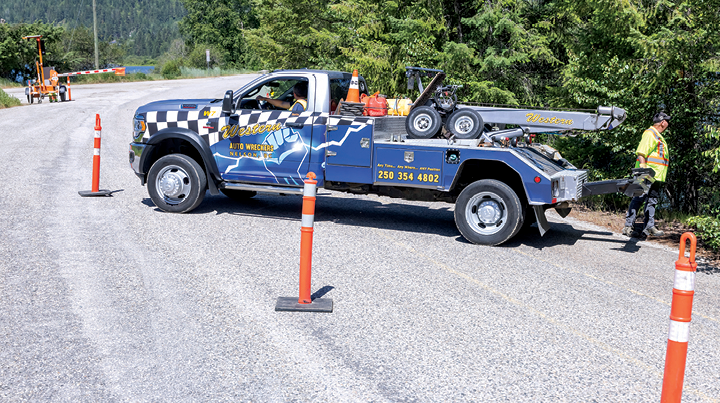
In the West Kootenays, Western Auto Wreckers & Towing faces a different set of challenges. The company works on winding mountain roads where conditions can change quickly. They often have to recover vehicles that have left the road and gone down steep embankments.
“For those hard recoveries, junior team members work alongside experienced tow operators to learn how to assess risks,” says Cody McKenzie, general manager of Western Auto Wreckers & Towing.
Before a vehicle recovery, crews review the work plan, identify hazards, and assess the risks. Factors such as traffic volume, visibility, weather, road conditions, and the location of the vehicle help determine what controls are needed to protect workers.
“Every recovery is different,” says McKenzie. “We assess the risks and put the appropriate controls in place before work begins.”
Traffic control helps protect crews working on narrow roads with limited space. Western Auto operates its own flagging unit, allowing tow operators and flaggers to be dispatched together. The company also manages its traffic control plans and procedures. Where recovery work goes beyond 15 minutes, traffic control persons may be required.
Know the risks before work begins
Before a tow begins, employers need enough information to assess risks.
Vehicle location, traffic levels, visibility, and weather help determine traffic control equipment and additional resources needed.
Roadside towing often requires several groups to work together. Depending on the situation, these groups can include towing companies, traffic control providers, and ICBC. When partners understand their roles and share information early, crews arrive better prepared to work safely.
“We’re counting on the expertise of the tow operator to pass along information to us,” says Robert Johnston, director of Traffic Services, Western Region with Universal Group. “The more information traffic control crews receive before arriving on scene, the safer the operation can be.”
There’s no such thing as a routine tow
Safe towing begins before a truck arrives on scene. Not all risks can be eliminated, but they can be managed. Planning ahead, assessing risks, and putting the right controls in place help get workers home safely at the end of the day.
For more information
Learn more about working around traffic on worksafebc.com. Also refer to the resources and training information:
- Occupational Health and Safety Regulation, Part 18: Traffic control — requirements for traffic control during roadside work.
- Traffic Management Manual for Work on Roadways (TMM) — guidance from the Province of British Columbia on traffic control planning and work zone setup.
- Towing & Recovery Training — Automotive Retailers Association training for towing and recovery operations.
This article originally appeared in the Fall 2026 issue of WorkSafe Magazine.
To read more or to subscribe, visit WorkSafe Magazine.
More in this issue
- Ask an officer: Training and orienting new and young workers
- Setting up for success with small tools training
- Turning safety into a habit for young workers
- Stitching safety into every step
- Building respectful workplaces in tourism and hospitality
- Preparing for regulatory updates
- Making it easier to connect with us