
Heat stress
Translations available in: 简体中文 | 繁體中文 | ਪੰਜਾਬੀ | Español | English
Heat stress happens when our bodies heat up faster than they cool down, and it can lead to serious health effects. Although sweating cools our bodies down naturally, this might not be enough for workers in hot environments.
Workers can be at risk of heat stress in any industry. All employers are responsible for managing the risk of heat stress in their workplaces.
- How workers are exposed
- The risks for workers
- Measuring the risk
- How to protect workers
- Resources
How workers are exposed
There are three main causes of heat stress:
| The environment |
|
| The work |
|
| The worker |
|
The risks for workers
Employers should train workers to be aware of these early signs of heat stress in themselves and others:
- Excess sweating
- Muscle cramps
- Weakness, fatigue, and dizziness
- Nausea
Heat stress can also result in reduced physical and mental ability. This in turn can lead to an increased risk of workplace incidents.
If heat stress is not recognized and treated early, it can lead to heat disorders, such as heat exhaustion or heat stroke. Signs and symptoms include:
- Agitation and confusion
- Increased or irregular heart rate
- Decreased consciousness and awareness
- Seizures
Measuring the risk
If your workers may be exposed to heat conditions, you need to assess the potential for heat stress.
There are four methods to determine whether workers are exposed to harmful heat conditions:
- Using the Humidex method
- Using the wet bulb globe thermometer (WBGT) method
- Measuring body temperature
- Measuring heart rate
Which method you use depends on the conditions of your workplace. Use the Heat stress screening tool to help you select the appropriate method. You can also refer to the publication Methods for Measuring Heat Strain or Stress.
If workers may be at risk of heat stress, you need to develop and implement a heat stress exposure control plan. See OHS Guidelines G7.29-5 for more information.
Safe work in hot conditions depends on several factors. Temperature alone cannot be used to predict the risk of heat stress. Employers should develop a heat‑stress exposure control plan before hot weather begins. Start monitoring environmental conditions as temperatures approach 23°C to 25°C, and add more controls as temperatures get hotter. These temperatures are not exposure limits. They are an early indicator of when to begin measures for managing heat stress. Heat stress can occur at lower temperatures, particularly if workers wear PPE or clothing that impairs the body's ability to cool itself.
How to protect workers
The most effective way to reduce the risk of heat stress is to eliminate the source of exposure. If that’s not possible, there are other risk controls to use.
Risk controls
-
1
Elimination or substitution
If you can eliminate the heat hazard or substitute a safer process away from the heat source, this is the most effective control. For example:
- Cancel or postpone the work until heat conditions improve
- Move the work to a cooler environment
- Replace highly strenuous work with less strenuous activities
-
2
Engineering controls
Making physical modifications to facilities, equipment, and processes can reduce worker exposure to heat. Some examples of engineering controls:
- Automate work or provide mechanical assistance
- Install air conditioning, misting stations, or evaporative cooling units, and ensure they are properly maintained
- Install exhaust hoods over heat-producing equipment, and ensure make-up air systems are balanced with exhaust to prevent heat buildup
- Improve ventilation or air movement
- Insulate or cover hot surfaces to reduce radiant heat
- Install shields, barriers, or reflective window coverings to protect workers from sources of heat
- Provide movable shade structures for outdoor work that can be repositioned with workers
- Use air-conditioned vehicles, trailers, or equipment cabs as cooling stations
- Reduce humidity
- Install temperature-monitoring devices to support timely implementation of other controls
-
3
Administrative controls
Changing work practices and work policies, awareness tools, and training can limit the risk of heat stress. For example:
- Reschedule work, particularly tasks requiring high exertion, to avoid the hottest parts of the day or times of the year
- Alternate physically demanding tasks with lighter work to reduce cumulative heat load across the day
- Schedule staff and work to allow time for work-rest cycles
- Separate workers from heat-producing equipment and processes
- Acclimatize workers to heat conditions
- Have workers rotate work between hotter and cooler environments
- Provide cool-down areas for workers to rest and recover
- Provide access to cool water
- Increase supervision, implement a buddy system, or increase check-ins for workers working alone to monitor for early signs of heat stress
- Train workers in how to recognize early signs of heat stress and the procedures to follow
-
4
Personal protective equipment (PPE) and clothing
PPE is not an effective control for heat stress in most cases, and wearing some types of personal protective clothing can actually increase heat stress. Heat-reflective clothing or cooling suits may be appropriate in some situations.
Workers should wear lightweight, breathable, moisture-wicking work clothing whenever possible to help regulate their body temperature.
The following are additional, industry-specific examples of risk controls.
Agriculture
- Provide insulated water containers or coolers with ice so workers have continuous access to cool drinking water throughout the day
- Provide workers with cooling bandanas
- Postpone activities needing PPE that could add to workers’ heat stress, such as pesticide application
Construction
- Provide insulated water containers or coolers with ice so workers have continuous access to cool drinking water throughout the day
- Provide workers with cooling bandanas
- Provide evaporative, cooling fabrics for neck shades and crown coolers to be worn under hard hats
- Do fabrication and preparation work off-site in cooler environments to reduce time spent on high-heat worksites
Food and beverage services (restaurants, food trucks)
- Replace menu items that require high-heat cooking methods with lower-heat alternatives
- Minimize tasks that require multiple types of heat-producing equipment (e.g., grills, fryers, ovens) running at the same time
- Separate food preparation, plating, and dishwashing areas from heat-generating appliances
- Rotate staff between higher heat tasks (cookline positions) and lower heat tasks
- Use pre-prepared ingredients
- Install roof-mounted exhaust fans and hood systems in food trucks and mobile kitchens
- Park food trucks in the shade
Health care and social services (home care)
- Look for opportunities to arrange visits with homecare clients in an air-conditioned environment such as a clinic or hospital
- Ask clients to turn on available cooling devices in their homes and block sunlight from windows with curtains or blinds prior to the worker’s visit
- Train workers to do a point-of-care risk assessment for heat risks
Landscaping
- Use riding mowers instead of push mowers
- Use battery-powered tools that generate less heat than gas-powered equipment
- Minimize or rotate tasks using heat-generating equipment (e.g., backpack blowers, hedge trimmers, string trimmers), and tasks with equipment that restricts airflow around the torso or back (e.g., blower harnesses)
- Park vehicles to create temporary shade blocks
- Provide insulated water containers or coolers with ice so workers have continuous access to cool drinking water throughout the day
- Provide cooling bandanas
- Limit or reschedule work on surfaces that can reflect heat (e.g., pavers, concrete, stone, asphalt)
- Wet hardscape surfaces to reduce radiant heat during landscaping work such as stone placement or joint-sanding
- Use high-reflectance or permeable hardscape materials
- Use light-colored ground coverings or drop sheets during staged landscaping work to reduce heat absorption
Warehousing
- Install reflective roofing materials to reflect sunlight and reduce the buildup of heat
- Install air curtains at loading docks or frequently opened doors to prevent hot outside air from entering the warehouse
- Use high volume low speed (HVLS) fans to create a consistent breeze
Many health and safety associations have additional industry-specific guidance.
See the resources below and the OHS Guidelines for more information.
Resources
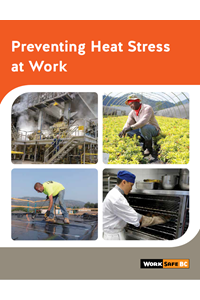
Preventing Heat Stress at Work
This book provides guidance on identifying and managing heat risks in the workplace. It explains how heat stress occurs and outlines effective prevention strategies. It also describes how to recognize...
Title

Heat stress screening tool
Working in a hot environment can cause heat stress, which can lead to serious health problems. Employers can use this interactive tool to help evaluate when workers may be at risk of heat stress and...
Title
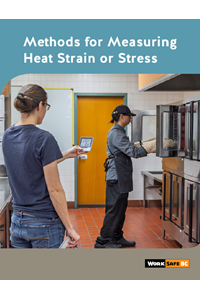
Methods for Measuring Heat Strain or Stress
When workers are exposed to hot or humid conditions, employers need to measure heat stress. This book outlines four methods for measuring heat stress to protect workers. It also explains when each method...
Title
Sun Safety at Work: Workers
Outdoor workers are up to 3.5 times more likely than indoor workers to develop skin cancer and are at a higher risk of experiencing heat stress. This video illustrates the dangers of sun exposure and...