
Reporting injuries online made better
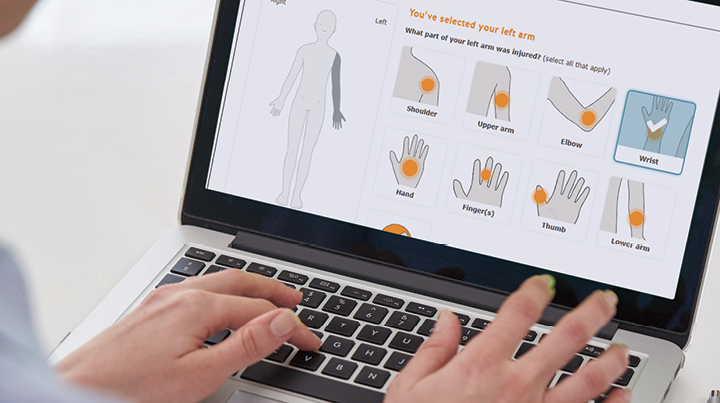
WorkSafeBC’s new online reporting experience makes injury reporting easier and more convenient. With a human-centred design, it helps injured workers feel supported from the start of a claim.
By Tanya Colledge
For many injured workers, reporting an injury marks their very first interaction with WorkSafeBC — often during one of the most stressful moments of their lives. That first impression matters.
Now, WorkSafeBC’s new online injury reporting form is making that first step clearer, simpler, and more supportive, marking a meaningful shift in how we connect with workers at the very beginning of a claim.
Listening and learning from workers
When someone is injured at work, the injury must be reported to WorkSafeBC. The information we gather at the reporting stage is important to ensure there are no delays in starting a worker’s claim for services and benefits.
“We had heard from injured workers as well as from our own staff that the current online reporting tool wasn’t meeting their needs. The form wasn’t compatible with mobile devices; it was long and complicated — which often resulted in workers abandoning the process and calling in instead,” says Niraj Thakore, a senior manager in WorkSafeBC’s Intake Services.
To make sure the new form truly met workers’ needs, Thakore, along with specialists in our Marketing and Communications department, held a series of focus groups with workers and team members from other WorkSafeBC departments. Their insights helped identify where people struggled most and guided every improvement to make the process simpler and more intuitive.
“We really focused on providing ‘just-in-time’ information,” says Thakore. “That meant paring the online form down to the essentials — only what’s needed to get a claim started. Our teams can always reach out later if more details are required.”
Based on research and feedback, improvements include:
- Ability to save your information: The form requires you to log in, allowing your information to be saved automatically as you fill it out.
- Mobile-friendly design: You can complete the form on any device and access it 24 hours a day, 7 days a week.
- Easy-to-understand questions: The questions are simplified and relevant to your situation. The form walks you through each step, with dynamic fields that offer you the option to share more details if needed.
- User-friendly navigation and visuals: You’ll see your progress as you move through the form sections and use visuals to indicate which part of your body was injured.
Making a measurable impact
Since its launch earlier this year, the redesign has seen up to a 96 percent successful submission rate, with about half of the people reporting their injuries on a mobile device, and the remainder from a laptop or desktop.
“This was one of the best websites I have used! The steps were straightforward for the most part; it was split into manageable chunks, and I really appreciated the ability to save partway (especially because of the concussion),” said one worker after completing the form.
Another worker said: “I felt that I was able to give all the information that I thought mattered to you. Which made me feel that every detail you asked for mattered. Improving my reporting experience.”
In keeping with our commitment to both reconciliation and the principles of equity, diversity, and inclusion, the reporting form also includes updated demographic fields that give workers the option to disclose their gender, sex assigned at birth, pronouns, and Indigenous identity. Workers can also update their demographic information at any time through the online services portal or by requesting Claims staff to do so on their behalf.
Building on a strong first impression
With annual claim submissions exceeding 140,000 over the last four years, the new reporting form has been rolled out in phases. This roll-out allows us to refine features and build on real-world feedback from workers and employers.
The current online injury reporting form is designed for workers with a physical injury from a single incident at work — covering roughly three‑quarters of all worker injury reports. Teleclaim is still the best option to report an injury or illness in specific circumstances (such as mental health injuries, hearing loss, gradual-onset injuries, or occupational disease), or if workers have questions.
“We’ve always said this work would evolve as we learn,” says Thakore. “We really appreciate when workers take the time to share feedback, and we want to show that we’re listening and using that input to make the experience better. The goal is to create a process that feels easy, dependable, and human-centred from start to finish.”
For more information
Employers are encouraged to share this information with their teams, update internal health and safety communications channels, and help workers understand that online reporting is now the easiest and most convenient option.
To see how online injury reporting works, visit How to report an injury and what to expect or watch the explainer video on YouTube.
Employers can also order updated resources, including posters and wallet cards with QR codes, from the WorkSafeBC Bookstore at worksafebcstore.com.
This article originally appeared in the Winter 2025 issue of WorkSafe Magazine.
To read more or to subscribe, visit WorkSafe Magazine.