
Reducing MSI risks in retail workplaces
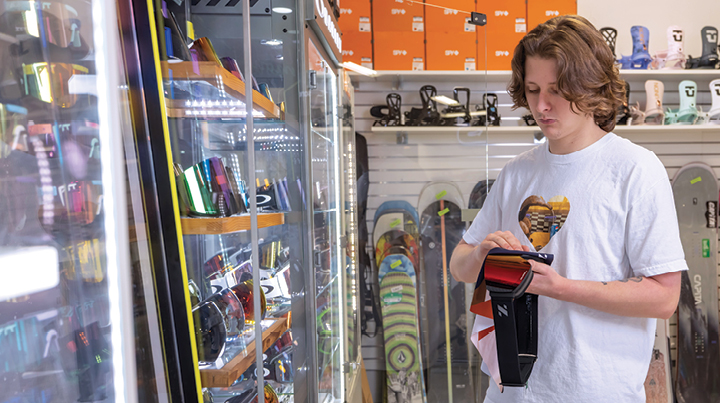
Following a push to engage with sector representatives, a new suite of tools and resources is now available to help retailers make MSI health and safety gains.
By Sarah Ripplinger
Musculoskeletal injuries (MSIs) are one of the most prevalent and preventable workplace injuries in the retail sector. They are defined as any injury or disorder that affects a worker’s muscles, tendons, ligaments, joints, nerves, blood vessels, or other soft tissues, particularly in the neck, shoulders, arms, wrists, legs, and back. Often characterized as sprains, strains, and inflammation, MSIs can become progressive and potentially debilitating if not properly addressed, leading to time off work.
In 2022, WorkSafeBC partnered with the Retail Council of Canada (RCC) to engage in an intensive process to better support the retail sector in reducing MSIs. This resulted in the development of practical tools, training resources, and inspectional guidance to empower employers and workers to become leaders in MSI injury prevention.
MSIs account for 38 percent of claims in retail, compared to 34 percent across all industries in British Columbia. “A challenge that we faced was how to develop MSI messaging that would be applicable to all employers and employees in a sector that is highly diverse,” comments Greg Wilson, director of government relations (B.C.) for the RCC. “We have over 15,400 employers — employing more than 340,000 workers — in the province. These employers range from large supermarket chains to small independent clothing shops, and everything in between.”
Developing the MSI prevention program
In 2022, RCC contracted seasoned ergonomist Dr. Dan Robinson, retired president and founder of Robinson Ergonomics Inc., to lead an industry consultation. Robinson and the RCC assembled a working group of safety personnel from a broad swath of retailers, including grocery, liquor, lumber, hardware, and home appliance and electronics establishments. He also visited retail storefronts, reviewing company safety materials, and speaking with workers about their day-to-day tasks and workspaces.
“Part of the intent was to learn from what individual retailers found as challenges, what they had accomplished in their MSI programs, and where there may be gaps in the materials available to them,” Robinson explains.
Following the consultation, Robinson and the RCC began creating a framework for their MSI Prevention program, in collaboration with WorkSafeBC and the retail stakeholder group.
“These materials are designed to make it easier for retailers to perform the required risk factor assessments, employee education, and identification of appropriate risk controls for MSIs,” Robinson highlights. “They include ‘MSI risk assessor training slides’ (also called ‘train the trainer’) that support developing in-house skills to perform the steps needed for ongoing MSI risk management.”
Starting with requirements
“The program can support building MSI risk reduction programs tailored to individual workplaces,” notes Tami Der, industry and program specialist with WorkSafeBC’s Prevention Programs and Services. However, Der emphasizes that it should be a second step after employers have already familiarized themselves with their requirements under the Occupational Health and Safety Regulation and Guidelines.
The OHS Regulation outlines ergonomics and MSI requirements for employers, including the MSI risk identification and review process, and employee education and training. Employers are also required to consult with their joint health and safety committee or worker health and safety representative on MSI risk identification, assessment, and controls, among other requirements.
Assessing MSI risks
Under the OHS Regulation, employers must conduct assessments for MSI risks in the workplace. When factors that pose a potential MSI risk have been identified, the employer must ensure that the risk to workers is assessed.
Risk assessments evaluate the magnitude (how much), frequency (how often), and duration (how long) of exposure to risk factors. The longer the duration of exposure to risk factors, the greater potential for risk of injury and the need to consider controls.
This information helps employers prioritize where to implement controls and which risk factors to eliminate or reduce. By identifying specific tasks and understanding the degree of exposure, employers can take targeted steps to protect workers and improve safety outcomes.
“Don’t wait until a worker becomes injured to conduct an evaluation of their job,” adds Der. “Instead, figure out ahead of time where the limit should be set for specific tasks to prevent injury.”
The RCC’s Prevention Program and WorkSafeBC’s Guide to MSI risk assessment and MSI risk assessment worksheet can help employers conduct MSI risk assessments.
WorkSafeBC’s website also features a Lift/Lower Calculator — helping estimate whether a lift has a low, moderate, or high risk of injury — along with a Push/Pull/Carry Calculator that estimates suggested maximum forces for pushing, pulling, and carrying a defined amount of weight for varying distances.
Controlling MSI risks
After a risk assessment, employers must control MSI risks through elimination. If not possible, minimize the risk by following the hierarchy of controls. This graduated series of controls moves from the most effective to less effective, but still important, controls in the following order: Elimination, substitution, engineering, administrative, and personal protective equipment (PPE).
Engineering controls are physical modifications to the work environment, equipment, and processes to reduce the risk of MSIs. They can include mechanical lifting aids — such as carts, hoists, pallet jacks, or conveyors — as well as adjusting the work environment to limit the distance heavy objects need to be lifted or carried, such as rearranging shelving to be at knee-to-waist height or redistributing loads across smaller units. It can also involve modifications to equipment or workspaces to limit awkward postures, twisting, and stooping.
Workers must be trained on any controls implemented, whether that be an engineering control or changes to work process. “We try to keep our heavy inventory close to where it’s needed,” shares Chris Malone, owner of Coastal Riders, a family-owned ski, snowboard, and skateboard shop in Surrey, B.C. “For example, the customer fitting area for ski boots is located near our back-room storage.”
“On our showroom floor, all of our merchandising racks and bigger display cases are on wheels to facilitate their movement,” Malone adds. “We change the floor layout often to help us work smarter, not harder, keeping the showroom airy and well-organized and creating clear paths of travel for staff and customers with baby strollers or oversized bags.”
Once controls have been implemented, it’s important for employers to monitor their effectiveness. This will ensure MSI risks are eliminated or minimized, improving workers’ safety and comfort.
Teaching proactive ergonomics
Ergonomics is the way workers move through and interact with their physical environment in the workplace. When done right, workplace conditions and job demands match the capabilities of individual workers, preventing MSI injuries and time off work, and supporting worker satisfaction and performance.
Many of Malone’s six-to-ten seasonal and full-time workers have been with him since he purchased Coastal Riders in 2014. Malone gives some of the credit for retaining workers in a sector known for higher turnover rates to his focus on creating a safe and rewarding work culture.
“All new hires are trained in tasks with a senior staff member first,” shares Malone. Staff are encouraged to take their time and ask questions if they are unsure about something. “We teach staff how and when to use ladders, to lift correctly and safely, to lift only what feels comfortable, to use a dolly when needed, and things like that.”
Administrative measures help control the risks of MSIs. These can include rotating staff through a series of tasks, using different muscle groups to reduce strain, along with proper training on each task.
“For example, rotating cashiers between the check stands, using the hand wand to price-check on the floor, and boxing items is a good way to limit MSIs,” says Der.
After thorough exploration of engineering and administrative controls, employers should apply PPE controls. At Coastal Riders, PPE is particularly important for workers using the company’s sharpening or waxing machines. Their PPE includes protective eyewear, gloves, and hearing protection.
Encouraging early reporting
MSI onset can be gradual, making early reporting essential to minimize the risk of long-term injuries. Employers should encourage workers to report any signs and symptoms of an MSI to their supervisor. Actions should then be taken to seek opportunities to minimize MSI risks by modifying the worker’s environment or tasks, and for the worker to receive medical attention, if needed.
Employee education should cover how to identify the signs and symptoms of MSIs, as well as the risk of MSI in the workplace, and how to report both risks and injuries to their employer.
“Worker education on MSIs provides the basis for early reporting, reducing the risk of a long recovery,” states Tami Perkins, an ergonomist with WorkSafeBC who provided feedback on the RCC program.
Designing stores for safety
Retail employers can also benefit from what is known as an inherently safer design, which builds ergonomic features and tools into new or retrofitted workspaces and systems, eliminating or minimizing MSI hazards from the outset. “Inherently safer design will save you so much time and money in the long run,” Der underscores.
The “MSI prevention: Ergonomic guidance for retail store design and configuration” document included in the program guides employers through workspace design tips for laying out retail environments and selecting equipment.
“Our goal is for employers to shift away from a reactive approach to MSI prevention,” says WorkSafeBC ergonomist Sania Safari, who also provided feedback on the program. “This can include considerations such as the placement of frequently handled items within an optimal lifting zone near the employee, limiting exposure to increased forces to perform tasks.”
After over three decades of ergonomics consulting in retail, Robinson says that he sees positive change afoot in the sector.
“I have seen steady improvement in the design of retail spaces in the back and front of stores to make work safer,” says Robinson. “I’ve also noticed increased efforts to accommodate individual differences in employee size or strength, employee training to minimize risks, and a recognition that employee retention is of value and good for business.”
For more information
Learn more by searching “RCC MSI Prevention Program” on the Retail Council of Canada’s website. You can also review our Ergonomics page to find useful tools and links to resources mentioned in this article. To reach the WorkSafeBC ergonomics team, email HumanFactors@worksafebc.com.
This article originally appeared in the Winter 2025 issue of WorkSafe Magazine.
To read more or to subscribe, visit WorkSafe Magazine.