
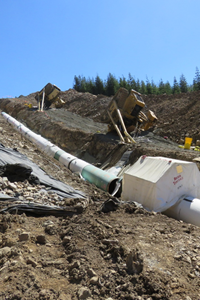
Two side-boom pipelayers operating in tandem rolled over
Date of incident: July 2022
Notice of incident number: 2022182060065
Employer: Pipeline construction company
Incident summary
Workers were operating two side-boom pipelayers (heavy equipment used to lift and move pipes) in tandem to carry a 55 m long section of 122 cm diameter pipe backward downslope on a pipeline project’s right-of-way. While carrying the pipe, the downslope pipelayer encountered a teeter point followed by a soft spot on the right-of-way. The rear end of the pipelayer’s right track sank into the soft spot as it came over the teeter point, and both pipelayers rolled over backward. No workers were injured.
Investigation conclusions
Cause
- Load swing resulted in loss of fore-aft stability of pipelayers. The section of the right-of-way the pipelayers were travelling down had a 17.5° slope, along with a 3.7° cross slope (side-to-side slope) at the teeter point. The rear end of the right track of the downslope pipelayer tipped down and to the right as it came over the teeter point and into the soft spot, contributing to load swing (that is, increasing the amount the pipe being carried was swinging). The energy generated by the load swing overcame the pipelayers’ fore-aft stability and caused both pipelayers to roll over backward downslope.
Contributing factors
- Boom overhang and load position. The short (1 m) boom overhang (distance of the load from the machine) at the time of the incident decreased the fore-aft stability of the pipelayers. In addition, the elevated position of the pipe being carried decreased the pipelayer operators’ ability to drop the load quickly to neutralize the load swing. Carrying the load in this manner did not align with the employer’s training on side-boom pipelayers or industry best practices.
- Condition of right-of-way. The downslope pipelayer sank into a soft spot in the right-of-way that was hidden by gravel that had been added to the right-of-way the day before. The gravel was not sufficient to support the combined weight of the pipelayer and the load.
- Knowledge gap. The lift plan completed before the incident indicated that the boom overhang would affect overall lifting capacity, but it did not indicate in which way — that is, whether more or less overhang would result in more or less capacity. The employer’s training program correctly taught that a lower boom (more overhang) paired with carrying loads low to the ground would result in more capacity on slopes. However, the pipelayer’s load moment indication (LMI) system (a device that monitors slope and carrying conditions) and other documents designed for level ground conditions provided contradicting instructions to the workers. This increased the risk of confusion and human error.
- Safety factor used in load calculations. At the time of the incident, the weight of the load fell within the employer’s allowable limits for that slope. However, the employer used a 1.33 safety factor in the load capacity calculations when working on that slope (that is, it reduced the capacity of the pipelayer by 25%). This safety factor was insufficient given the context of the work taking place. Less weight would have increased the stability of the pipelayers at the time of the incident.
- Machine selection. The upslope pipelayer had an extended 10.5 m boom, which reduced its capacity and the overall capacity of the tandem lift when hoisting and travelling on slopes. The downslope pipelayer had a shorter boom and was more suitable for work on slopes. There were a variety of pipelayers with varying boom lengths working on this section of the pipeline.
2021-04-22 20:42:33