
Understand how combustible dusts can cause harm
Combustible dusts are a serious workplace hazard that’s easy to overlook. Fine particles from materials like wood, metal, grain, or plastic may catch fire.
Understanding the risks of combustible dust helps you reduce them and meet your requirements.

If you’re not sure if the OHS Regulation applies to you, see Combustible dusts roles & responsibilities.
What are combustible dusts?
Most dusts are combustible, which means they can easily catch fire and burn. The finer a dust is, the more likely it is to catch fire. If fine dust particles catch fire when suspended in air, the fire can spread rapidly. Under some conditions, this may result in an explosion.
Combustible dusts can come from many materials that break down into fine particles. These include:
- Organic substances (e.g., wood, grain, paper, lint, plastics, rubber)
- Metallic substances (e.g., aluminum, iron, nickel, titanium)
- Chemical substances (e.g., pesticides, pharmaceuticals)
If your workplace produces, handles, or stores fine particles from materials like these, treat the dust as combustible until you know otherwise.
Combustible dusts can be:
- Ignitable. Dusts can catch fire when they build up on a surface and come into contact with a spark or other ignition source, such as fire. The more dust that builds up, the more fuel there is for a fire.
- Deflagrable. When fine dusts suspended in air are in the right concentration and come into contact with an ignition source, they can catch fire. The spread of fire through a dust cloud is called a deflagration. Deflagrations spread rapidly outward from the point of ignition. When this happens in an enclosed or partially enclosed space, an explosion can occur.
A dust can be ignitable, deflagrable, or both. You can’t tell just by looking at it. To learn more, see Identify & assess combustible dusts in your workplace.
Combustible dust fires and explosions
A dust fire or explosion can escalate quickly and cause serious injury or death.
There are different types of dust fires:
- Fire. When dust is exposed to an ignition source and enough oxygen, it burns like any other fuel.
- Flash fire. When dust suspended in the air catches fire, it burns rapidly through the dust cloud.
- Deflagration. When suspended dust forms a cloud with the right concentration, a fire in the dust cloud will spread extremely quickly.
- Explosion. When the pressure from a deflagration builds up enough to break the enclosure, an explosion happens. Explosions can injure workers through:
- Fire
- The force of the pressure release
- Flying debris
How combustible dust explosions happen
A combustible dust explosion is when dust catches fire and causes pressure to build up inside an enclosure. This causes it to burst or rupture. Heat and pressure build up very quickly. Five basic conditions can cause this type of explosion. Together, they’re called the “dust explosion pentagon”:
- Fuel to burn: The combustible dust
- Dispersion: A high concentration of fine dust suspended in the air
- Oxygen: Enough oxygen in the air to sustain the fire
- Ignition: A source of heat or energy, such as a spark, hot surface, overheated equipment, or static electricity
- Confinement: An enclosed space where pressure can build, like a building, silo, or piece of equipment
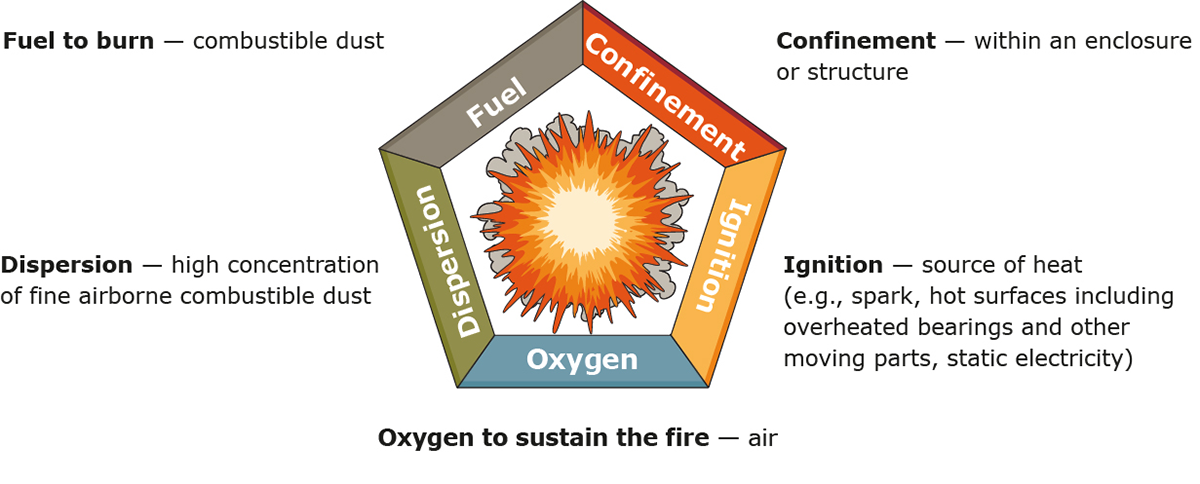
If a high concentration of combustible dust at your workplace becomes airborne and contacts an ignition source in a confined area, an explosion will likely occur.
Removing any one of these five conditions lowers your risk, but may not eliminate risk. For example, removing confinement won't stop a flash fire from happening. It only prevents the pressure buildup that causes an explosion. That's why a combustible dust management program needs layers of controls, not just one.
Please note: The content on this page is intended to help you understand and meet the requirements of the Occupational Health and Safety Regulation. More detailed information can be found in the OHS Guidelines and/or OHS Regulation.