
Demystifying workplace inspections
Published on: June 8, 2026
A good inspection can prevent injuries, save time, and reduce costly surprises. It helps workplaces spot issues early and strengthen safety practices.
By Sarah Ripplinger
In B.C. workplaces, inspections happen in two main ways. Employers carry out regular checks of their workplaces, equipment, and work processes. WorkSafeBC prevention officers also visit workplaces to review safety practices and support improvements. These inspections give employers a chance to ask questions and learn practical ways to improve safety.
“Inspections are meant to support employers,” says Tami Der, an industry and program specialist with WorkSafeBC. “Officers are there to help prevent health and safety issues that could harm workers.”
Inspections may also result in orders to address unsafe conditions or practices. These orders explain what must be fixed and ensure the work is done.
“Keeping workers safe is also good business,” Der adds.
Employers play a key role
Employers must carry out regular workplace inspections. These checks find hazards early and confirm that controls are working. Involving workers also supports a shared responsibility for safety.
At Congebec, a national multi-temperature logistics company, supervisors rotate between B.C. sites to support internal inspections. This approach promotes knowledge sharing and brings a fresh set of eyes to each location.
“It gives you a different perspective,” says Judina Arends, Vancouver operations manager. “When you see the same space every day, you can miss small issues. Rotating people around sites lets us catch more.”
Training is also essential. Warehouse supervisor Bobbie Jacques attends RackSafeBC sessions on racking inspections and maintenance in cold storage facilities.
“Every session is different,” she says. “Recently, I learned how to fix damaged racking instead of replacing everything.” She sees the meetings as practical and useful. “Seeing examples from other warehouses makes me want to improve our own.”
Inspections led by WorkSafeBC
WorkSafeBC prevention officers can inspect any workplace, at any time, with or without notice. These visits are opportunities for WorkSafeBC officers to introduce themselves to the workplace.
They give employers and workers a better understanding of their responsibilities and let them see officers as a source of health and safety information and support.
Some inspections are based on risk, such as the type of work or known hazards. But any workplace may be inspected as part of prevention efforts.
“Inspections can feel a bit nerve-wracking at first,” says Reba Hiebert, a people and culture specialist with Congebec. “But as I got to know the officers, I saw how valuable they are. Officers are a great resource.”
“Congebec is a good example of a company that takes safety seriously,” says Jesse Parker, a WorkSafeBC occupational safety officer. “When I first visited, their supervisor greeted me and showed a strong understanding of workplace safety.”
Who is involved
A prevention officer leads the inspection. Employers, supervisors, and workers are encouraged to take part because each group plays a vital role in safety.
Senior leaders may attend or send a representative. Supervisors should always be involved, because they share safety information with workers and help follow up on changes. Joint health and safety committees or worker safety representatives should also take part whenever possible.
What happens during an inspection
An inspection often begins with a review of basic workplace information. Officers may look at health and safety programs, first aid records, incident investigation reports, risk assessments, and work procedures. They may also speak with workers about how tasks are done.
Depending on the situation, an officer may walk through the whole workplace or focus on certain areas, such as equipment or maintenance work. They may take notes or photos to document what they see, and employers are also encouraged to write down what is discussed.
If issues are found, officers provide suggestions on ways to meet regulations. They may issue an order that outlines what must be done and when. Orders are a standard way to communicate requirements and support follow-up.
What orders mean for employers
One common concern for employers is what happens when an order is issued.
Orders or compliance agreements issued during an inspection do not directly raise premiums in themselves. Instead, they address risks that can lead to injuries and higher costs over time. If an order is issued, the officer will explain what needs to be done and set a timeline. During a follow-up visit, the officer checks that the work is complete. Orders are legally binding and must be followed within the timeline set by the officer.
Looking beyond the obvious
Inspections also consider risks that may not be immediately visible. Officers help identify hazards that can still cause serious harm, such as chemical exposures or repetitive strain.
Using a risk-based approach, they guide employers through the hierarchy of controls to reduce risks. The goal is to control the hazards that are most likely to cause injury.
Following the hierarchy of controls, employers should look at ways to:
- Eliminate the hazard
- Find a substitution
- Use engineering controls to isolate workers from the hazard
- Consider administrative controls to change the way people work
“Start by removing the hazard if you can,” says occupational safety officer Devon Hainsworth. “If not, look at safer alternatives, equipment, or changes to work practices. Personal protective equipment is important, but it’s the last line of defense.”
During inspections, officers may ask why higher-level controls were not used. If there’s a hazardous chemical being used for cleaning, for example, Hainsworth will ask: “Is there an alternative solution that doesn’t contain this chemical that can be used instead?”
Why a proactive approach matters
“The best advice I can give to employers is to ask questions,” says Parker. “We’re here to help.”
Reaching out early can prevent problems from becoming more complex or costly.
WorkSafeBC officers know safety requirements and regulations well. Reaching out early can save employers time and money later.
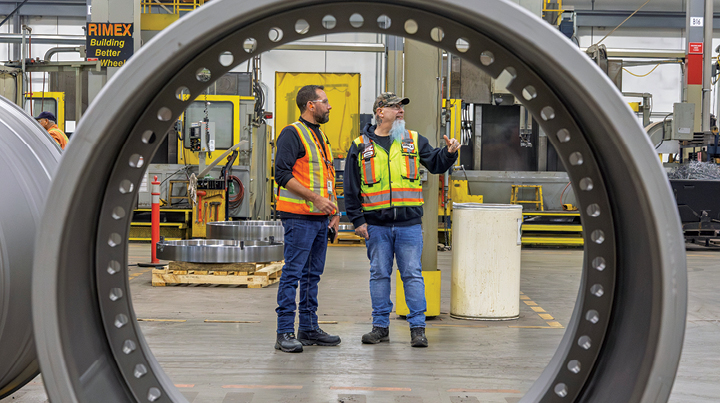
At RIMEX Supply Ltd., a manufacturer of wheels and rims, learning more about noise risks led to practical changes. The company installed decibel meters across its facilities to warn workers when noise levels are too high.
“RIMEX is a strong model of an employer that works closely with us,” says Leelond Wettstein, a WorkSafeBC occupational safety officer. “It shows in how they manage risk.”
Facilities manager for B.C. operations, Steve Bekessy, says his view of inspections has changed over time. He remembers feeling nervous during his first inspection years ago. He had just been hired by the firm as a millwright in 2012.
“WorkSafeBC has learned from many incidents over time,” he says. “They use that knowledge to make changes.” Now, Bekessy turns to prevention officers first when questions come up. “At the end of the day, do we want to redo work, or do it right the first time?”
After an incident
Some inspections take place after an incident. These inspections focus first on making the workplace safe. They may also help employers to identify what contributed to the incident so it does not happen again.
Turning findings into action
At metal manufacturer Aggressive Tube Bending, office administrator Andrea Leger has seen firsthand how inspections can strengthen safety programs.
“WorkSafeBC officers have the authority, but we all want the same thing,” shares Leger, who also sits on the Manufacturers’ Safety Council. “We want everyone to get home safe.”
With support from prevention officers, the company has built a stronger safety culture and improved its safety systems.
“When we have questions, officers don’t just point to the law,” Leger says. “They share guidelines, standards, and useful resources. Officers help us make improvements faster than doing it alone.”
Safety efforts work best when they’re seen as a long-term commitment that evolves as workplaces, hazards, and expectations change. “Workplace safety never stands still,” says Hainsworth. “It’s an ongoing journey.”
Inspections at a glance
Keep these key points in mind to get the most out of workplace inspections.
Employer-led inspections:
- Employers must carry out regular inspections to identify hazards early and check that controls are working.
- Involving workers supports a shared responsibility for safety.
- A consistent approach, including training and fresh perspectives, strengthens safety practices over time.
WorkSafeBC-led inspections:
- Prevention officers can inspect any workplace at any time, with or without notice.
- Inspections explain responsibilities, review safety systems, and identify risks.
- Orders are a normal part of the process and outline what must be corrected.
- A proactive approach, including asking questions early, leads to safer workplaces.
For more information
Learn more about workplace inspections by visiting the following pages on worksafebc.com:
- WorkSafeBC inspections: Helping you create a healthier and safer workplace
- Employers’ Advisors Office
Employers are also encouraged to contact their health and safety associations for assistance in building safety programs, strengthening skills through training, and adapting to changing workplace risks.
This article originally appeared in the Summer 2026 issue of WorkSafe Magazine.
To read more or to subscribe, visit WorkSafe Magazine.