
Protecting workers from traffic: Getting started
Published on: March 16, 2026
Protecting workers from the all-too-common risk of being struck by a vehicle is crucial. Preventing these incidents starts well before workers arrive on site.
To do this, employers must assess the risks associated with every roadside work zone and develop a traffic control plan that effectively eliminates or minimizes those risks. Traffic control plans must follow the order of controls set out in Section 18.3 of the Occupational Health and Safety Regulation, as well as the principles outlined in the 2020 Traffic Management Manual for Work on Roadways.
The best way to prevent struck-by incidents is to use a layered approach to risk controls, where several different controls work together to manage the risk to workers. A thorough risk assessment combined with effective controls and a worker orientation to the plan must be in place before any work begins.
Start with a risk assessment
All employers involved in roadside work, such as the road authority, prime contractor, and subcontractors, have responsibilities — responsibility is not limited to the traffic control provider. Risk assessments must consider the specific conditions of the worksite, for example:
- The duration of the work
- The type of work being performed, along with the presence and movement of equipment, materials, and people within the work zone
- Worker exposure to hazardous traffic (i.e., duration, proximity, volume, and speed)
Starting this planning early is critical. Identifying hazards and constraints in advance allows employers to select controls that are practicable, effective, and suited to the work
Develop and implement a traffic control plan
The traffic control plan must clearly describe how risks will be controlled using the hierarchy of controls — from elimination and engineering controls through to administrative controls and personal protective equipment. Employers must clearly demonstrate what is practicable in the context of the specific job, rather than relying on lower levels of controls, such as personal protective equipment.
What is practicable will depend on the nature of the work and how workers are exposed to the risk of hazardous traffic. Controls can be used either singularly or in combination. The goal is to eliminate risk or reduce it as much as possible.
Educate and orient all applicable workers
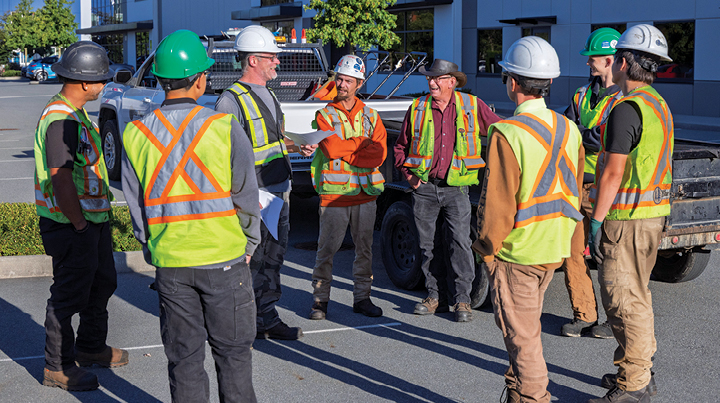
Every worker who may be affected by traffic hazards must be oriented to the site-specific risks and the traffic control plan. This includes workers from different employers, subcontractors, and those whose tasks bring them into the work zone.
Supervisors must ensure that new, young, or returning workers know and understand the hazards, the controls in place, and their responsibilities for following the plan.
Ensure effective supervision
Supervision plays a key role in ensuring traffic control measures are implemented as planned and monitored to ensure they are effective.
Re-assess risks and update plans as conditions change
Roadside work environments are dynamic. When conditions change, employers must re-assess the risks and update the traffic control plan and worker orientations accordingly.
For more information
Visit Working in and around traffic on worksafebc.com for more details and resources. Additional resources on work zone safety are available from Road Safety at Work.
This article originally appeared in the Spring 2026 issue of WorkSafe Magazine.
To read more or to subscribe, visit WorkSafe Magazine.
More in this issue
- Working safely around mobile equipment
- Ask an officer: Can workers wear personal audio devices as hearing protection?
- Licensing and certification transforming asbestos work in B.C.
- Take steps to prevent struck-by incidents
- Fresh lines on safety in commercial fishing
- Reporting tips and gratuities for service employers