
Working safely around mobile equipment
Published on: March 16, 2026
Smart safety systems at two B.C. pulp and wood product manufacturing operations ensure safe passage through busy equipment operating zones.
By Marnie Douglas
Mobile equipment is essential to day-to-day operations, but it also presents a serious hazard. Large trucks, forklifts, loaders, and delivery vehicles often operate in close proximity to pedestrians, while busy yards can have limited sightlines and multiple contractors on site.
Safe passage is possible, however, with proper controls. Through engineering controls, dedicated safety committees, and collaboration with WorkSafeBC officers, two major B.C. forest-products employers are building safer pathways for workers, contractors, and visitors.
At West Fraser Timber Co. Ltd., the employer’s safety approach shows up across its operations — including Cariboo Pulp, Williams Lake Plywood, and WestPine MDF — while Millar Western Forest Products Ltd. focuses its safety leadership at Quesnel River Pulp. These operations use a mobile equipment pedestrian interface (MEPI) system — a safety approach that layers a variety of control measures to prevent injury from struck-by incidents.
Designing safety into high-risk environments
When it comes to control measures, WorkSafeBC occupational safety officer Shane Campbell explains that eliminating a hazard is always the most effective option. In many industrial settings, however, mobile equipment cannot simply be removed from operations. This places an even greater importance on the next most effective measure: engineering controls that physically separate workers from hazards wherever possible.
“What I really like about this is that they’ve used purposeful engineering controls layered with other levels of controls. The thought that was put into these controls is exceptional,” he says.
Both employers have embraced this principle, investing in systems that reduce reliance on individual behaviour by designing safety directly into the work environment. Their MEPI systems aim to prevent struck-by incidents by creating clear, predictable, and protected pedestrian routes throughout their facilities.
A layered approach
Campbell notes that a MEPI system is a layered safety approach that combines engineered solutions, site-specific procedures, and ongoing oversight to manage interactions between pedestrians and mobile equipment.
West Fraser’s operations and Millar Western’s Quesnel River Pulp use MEPI systems that emphasize physical separation, controlled crossings, strong visibility measures, and clearly defined pedestrian routes.
Some examples of the MEPI systems include:
- A ground-projection system that displays clear pedestrian pathways
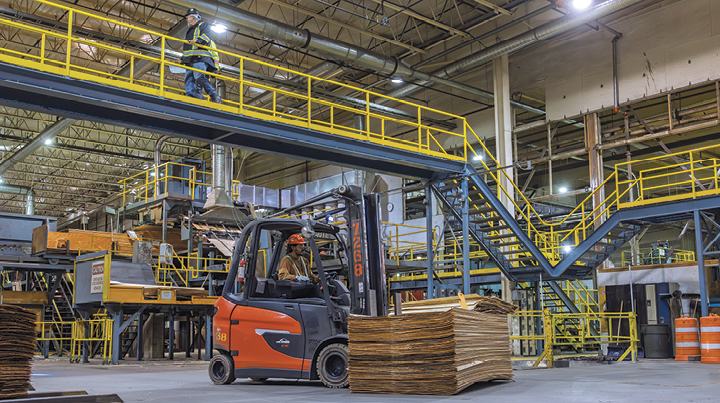
- Raised catwalks that separate pedestrians from mobile equipment
- Designated walkways and controlled crossings, supported by barriers, flashing lights, and audible alarms where needed
Both employers share a common belief that effective engineering controls are fundamental to preventing struck-by injuries. The specific placement and configuration of these controls vary by site, reflecting differences in layout, equipment, and traffic flow. What remains consistent is a focus on separating people from hazards through design rather than relying on personal vigilance.
West Fraser Timber: Adapting MEPI
West Fraser uses MEPI principles to manage pedestrian safety, adapting controls to meet its specific operational needs.
Lori Saretsky, West Fraser’s regional safety manager, says that in 2021 the company implemented a policy prohibiting people and mobile equipment from being in the same area at the same time. The policy requires either parking mobile equipment or putting effective safety controls in place, including barriers, communications, and PPE, supported by a permitting process to ensure the appropriate controls are in place.
“Each site must conduct a risk assessment, create a site map, and work with its safety committee to identify areas where people and mobile equipment interact, using the order of controls to eliminate or engineer out risks where possible,” says Saretsky.
The mill invested in the construction of a covered walkway area to enhance pedestrian safety. Engineering controls include barricaded and clearly painted footpaths, along with barrier-guarded, gated stops that require pedestrians to pause before crossing roadways. Administrative controls include eight flashing crosswalk systems and four solar-powered flashing speed-limit signs.
Millar Western: Managing complexity through design
Millar Western acquired Quesnel River Pulp from West Fraser in April 2024. Much of the MEPI system at Quesnel River Pulp was already in place, and maintaining and strengthening that system has remained a priority — reflecting a shared commitment to pedestrian safety across both organizations.
The most effective way to control these risks is to eliminate interactions between mobile equipment and workers. If you can’t eliminate all interactions, minimize the risk by using several types of controls that overlap and work together.
Safety coordinator Karla Griffin explains that the project started in spring 2021, when a MEPI Improvement Committee was convened. A more comprehensive MEPI risk assessment followed, and “with a clearer, quantifiable understanding of the site’s MEPI-related hazards, we began implementing additional controls to eliminate pedestrian-equipment interactions wherever possible.”
The engineering controls are designed to make pedestrian routes unmistakable. Griffin says these include barricaded, clearly painted walkways that guide foot traffic. Administrative controls include flashing crosswalks positioned at key pedestrian crossing points, solar-powered flashing speed-limit signage to slow vehicle traffic, and automated projected forklift warning lights that alert personnel when mobile equipment may be present at overhead door crossings.
In higher-risk areas, barriers with pedestrian gates prevent workers from stepping into vehicle pathways until it is safe to cross. These physical barriers automatically stop pedestrians, prompting them to pause, look, and proceed only when safe to do so.
During a WorkSafeBC inspection in October 2025, Campbell observed several of these measures in place. Rather than depending solely on training or signage, the worksite itself helps direct behaviour in safer ways, he adds.
“The interface between pedestrian and vehicle traffic creates one of the biggest risks at a jobsite. The MEPI system is an excellent example of a team working together to achieve a positive outcome for everyone’s safety at this pulp mill,” says Campbell.
Safety shaped by collaboration
Campbell notes that when safety controls are well designed and maintained, they reduce risk for everyone on site, including new workers, contractors, and visitors who may be less familiar with traffic patterns.
Engineering controls are most effective when they are actively monitored and maintained. Both employers have dedicated MEPI committees that play a central role in overseeing pedestrian-equipment interactions and ensuring MEPI systems remain effective over time.
Committee members regularly review site conditions, observe traffic patterns, and discuss potential improvements. They may assess near-miss reports, consider changes to operations, or evaluate whether new equipment or contractors introduce additional risks.
Saretsky says that each West Fraser site has its own safety committee to help complete hazard assessments, which are reviewed immediately after they are performed to ensure controls remain effective. They also hold calls where general managers present safety initiatives, allowing divisions to learn from one another and adopt effective practices across sites.
Griffin adds: “Our MEPI Improvement Committee remains active in 2026, and our joint health and safety committee also has an active presence, with a MEPI focus, at regular joint committee meetings.”
Bob Wurm, electrical & instrumentation supervisor and a joint committee member at Quesnel River Pulp, says buy-in from workers was key to the system’s success.
“For each control, we had a trial run to get people to understand what was coming. At first, it was a big change, and some were slow to adapt. But we specifically used a slow rollout to train people to access areas differently,” he says. “We took a phased approach, with consultation, to ensure that everyone was on board with the changes.”
They also use a suggestion box to get workers’ feedback on the MEPI system and share the input with the committee.
By involving workers, supervisors, and safety professionals, these committees help ensure controls remain relevant as the worksite changes. Their ongoing oversight reinforces the idea that pedestrian safety is not a static program but a living system that requires continual attention and adaptation.
Saretsky says the main ongoing challenge is educating and managing interactions with non-employees, such as delivery drivers, who may be unfamiliar with how the MEPI system works.
Building confidence through visible controls
For workers moving through busy industrial yards, clearly identifiable safety controls can provide reassurance that risks are being effectively managed. Barricaded walkways, guarded crossings, and traffic-calming measures — such as speed bumps and illuminated posted speed signage — send a clear message that pedestrian safety is a priority.
These controls also support consistency. When workers, contractors, and visitors all follow the same designated routes, vehicle operators can better anticipate pedestrian movement, further reducing the likelihood of incidents.
WorkSafeBC industry and program specialist Kim Stubbs notes that West Fraser has developed a unique data-reporting tool that tracks both leading and lagging indicators to help identify emerging hazards.
“Typically, employers focus on claims statistics, which track incidents after they’ve occurred. These are lagging indicators,” she explains. “Leading indicators — such as workplace inspections, field-level hazard assessments, supervisor observations, and worker feedback — are forward-looking measures that help identify hazards before an incident occurs.”
This data is entered into the tool to pinpoint where issues may arise and support continuous improvement.
“That West Fraser developed a tool to include leading indicators is significant. It’s very useful in preventing struck-by incidents involving mobile equipment,” she adds.
What other workplaces can learn
According to Campbell, the successes at West Fraser’s operations and Quesnel River Pulp offer practical lessons for other mills and industrial worksites where pedestrians and mobile equipment intersect.
“Struck-by risks are serious, but they are solvable. By reviewing traffic patterns, identifying high-risk interaction points, and investing in engineering controls such as barriers, gates, and designated walkways, employers can significantly reduce the likelihood of injuries.”
For more information
For employers ready to take a first step toward identifying the risk of pedestrians being struck by mobile equipment at their site, read Take steps to prevent struck-by incidents, which outlines a practical template that can be downloaded and used to map hazards and select effective controls.
You can also visit Reduce the risk of workers being struck by mobile equipment at worksafebc.com to learn more and download related resources.
This article originally appeared in the Spring 2026 issue of WorkSafe Magazine.
To read more or to subscribe, visit WorkSafe Magazine.
More in this issue
- Ask an officer: Can workers wear personal audio devices as hearing protection?
- Licensing and certification transforming asbestos work in B.C.
- Take steps to prevent struck-by incidents
- Fresh lines on safety in commercial fishing
- Protecting workers from traffic: Getting started
- Reporting tips and gratuities for service employers