
Fresh lines on safety in commercial fishing
Published on: March 16, 2026
A major revision to WorkSafeBC’s flagship health and safety book for commercial fishing offers accurate, visually engaging content to keep workers safe on the water.
By Marguerite Pigeon
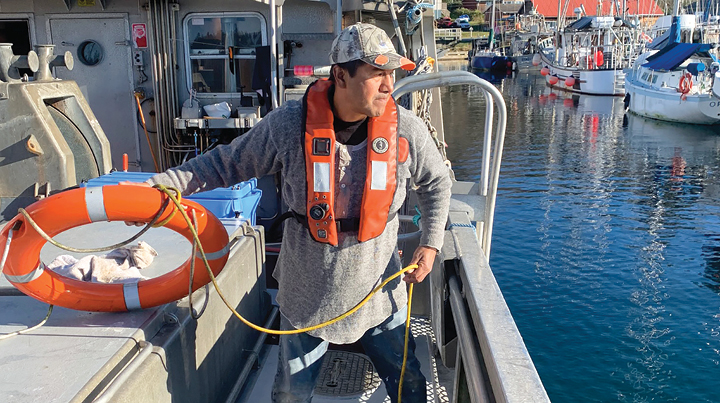
Commercial fishing vessels in B.C. carry an exceptionally diverse mix of gear — from deck equipment to nets and lines — making them hazardous to work on. Vessel instability and unsecured heavy equipment are two further hazards that can lead to injuries or even drowning.
WorkSafeBC recently published a revised edition of its health and safety book for fishing employers and workers. With fresh graphics and plain language to describe current legislation, the updated Gearing Up for Safety in Commercial Fishing leads the way to safety awareness at sea.
Starting conversations
Bruce Logan, an occupational safety officer with WorkSafeBC, who was part of the revision, says most fishing crews will keep a printed copy of Gearing Up in their cabin or galley for easy reference.
From there, he says, the book will spark meaningful dialogue among ship masters, crews, and safety officers. “The skipper might see something in the book, then when I’m next on the boat, they’ll ask me about it. We want to encourage those conversations.”
Enhancing clarity
Logan adds that while most fishing crews in B.C. are experienced and keenly aware of potential risks, young and new workers may need extra support in recognizing dangerous activities.
The new Gearing Up expands sections on young and new worker training requirements, plus gear-specific safety, with more task-based bullets. “If the book says a skipper or crew ‘must’ do this or that, we back up those instances with regulation.”
John Krgovich, program coordinator at Fish Safe, the fishing industry’s provincial safety advocacy group, says the book dovetails with his organization’s agenda.
“It’s a tool that lets us talk to fishermen about safety,” he explains. “They may read some information and ask, ‘Well, how do we do that?’ We’ll link them with a fisherman who’s trained as a safety advisor to help them.”
Teaming up
Revising the comprehensive publication was no small feat. “This was truly a collaborative effort. Our team went sentence by sentence with a fine-toothed comb,” says Logan, highlighting the many experts at WorkSafeBC who collaborated to make this update a reality.
Felicity Lawong, a resource development advisor on the team, agrees. “From subject-matter experts to designers and many others, we shared one goal: to create a clear, approachable safety resource for everyone in commercial fishing.”
Picturing safety
Logan points to the book’s new visuals as another improvement over the previous edition, adding that photographs were taken on board fishing boats to produce colourful illustrations of safety strategies.
Krgovich says the graphics will go a long way toward raising safety awareness in his industry. “A lot of fishermen shy away from anything that reads like a textbook. This book has succeeded in keeping things visually interesting.”
Shaping tomorrow
Logan, who’s seen fishing hazards up close as both a former fisher and in his current role as a safety officer, says the hard work on Gearing Up for Safety in Commercial Fishing will pay off by leading to better safety programs and injury prevention on boats.
“When a safety inspector boards a vessel and hands out this polished, informative resource, it creates the perfect segue to start a safety conversation.”
For more information
Read our newly updated Gearing Up for Safety in Commercial Fishing on worksafebc.com and visit Fishing & other marine industries for more resources. You can also learn about services and safety information at fishsafebc.com.
This article originally appeared in the Spring 2026 issue of WorkSafe Magazine.
To read more or to subscribe, visit WorkSafe Magazine.
More in this issue
- Working safely around mobile equipment
- Ask an officer: Can workers wear personal audio devices as hearing protection?
- Licensing and certification transforming asbestos work in B.C.
- Take steps to prevent struck-by incidents
- Protecting workers from traffic: Getting started
- Reporting tips and gratuities for service employers