
Steps to safer moves on campus
Published on: June 18, 2025
At the University of British Columbia’s Vancouver campus, a simple question sparked a major shift in safety culture: “How can we make moving appliances safer?” The search for an answer ignited collaboration, innovation, and renewed commitment to protecting workers.
By Marnie Douglas
At the University of British Columbia’s Vancouver campus, a simple question sparked a major shift in safety culture: “How can we make moving appliances safer?” The search for an answer ignited collaboration, innovation, and renewed commitment to protecting workers.
For years, workers tasked with moving appliances across several of UBC’s student housing units — including three-storey townhouses built for housing workers during Expo 86 — have navigated tight corners and narrow staircases without elevators. Appliances, which have only become larger and heavier over time, posed a significant risk of musculoskeletal injuries (MSIs), especially in older buildings with structural constraints. While there were no serious incidents, the strain on workers was evident.
Old buildings, new challenges
“It was just the way things had always been done,” says Sarah Brown, former sub-head tool crib/store operator with UBC’s Student Housing and Community Services (SHCS). “You’d remove railings or just grunt your way through awkward stairwells. But we finally asked why it had to be this way.”
That question led to a job demand analysis conducted by UBC’s ergonomics and accessibility team. Led by manager Abigail Overduin, the analysis examined the physical demands placed on workers handling large appliances, along with the impact of contributing risk factors.
“The analysis helped us step back and say, ‘This is difficult, and it’s becoming even more so,’” Overduin explains. “We didn’t want to wait for an injury to occur, and that gave us the momentum to look for a proactive solution.”
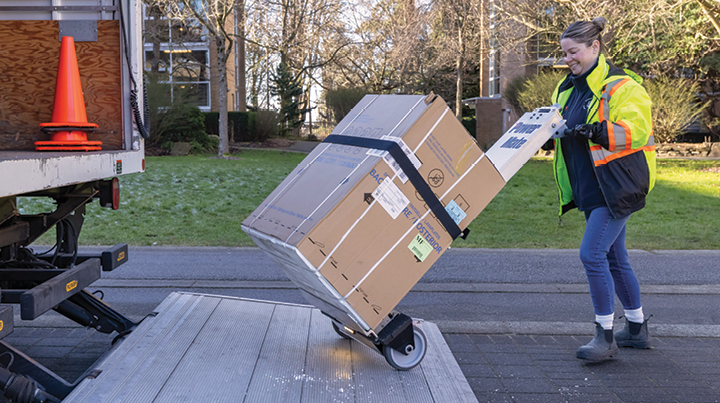
Enter the powered stair climber, a mechanized device that acts like a traditional dolly but with motorized tracks that help it safely scale stairs. Overduin and Brown worked closely to evaluate this option. They reached out to a vendor, analyzed the equipment, and found that while some moving situations required a platform accessory — particularly the tight L-shaped staircases in the older units — it had serious potential.
A custom-built fix for tight corners
However, one major challenge emerged: several of the stairwells had triangular-shaped landings that didn’t allow the stair climber to pivot safely between flights. Rather than abandoning the solution, the team turned to UBC’s carpentry department for help.
Claudia Popa, SHSC’s trades manager who also oversees the carpentry crew, recalls the challenge. “Sarah’s team came to us with the problem, and it was such a great example of cross-team collaboration. Our carpenters designed and built a custom wooden platform to temporarily rest the dolly on between stairs. It’s mobile and reversible, so it’s really practical.”
With the platform in place, the stair climber was ready for full deployment. SHCS now operates two of the machines, primarily during peak move-in and move-out periods.
WorkSafeBC occupational hygiene officer Jonathan Truefitt says it’s not always easy to make change when it comes to using engineering controls such as the powered stair climber, but he’s encouraged when employers like UBC take proactive steps.
Consulting workers who perform the tasks and are directly affected is essential during the MSI risk management process. The effectiveness of eliminating or minimizing MSI risk factors depends on worker engagement and participation.
“Understanding where there’s an issue and taking steps to mitigate it is really what’s important. It’s always about a risk management process,” he explains. “It’s also important to get buy-in from employees, allowing workers to have ownership over the process and the change.”
Although there is still a degree of risk when using a powered stair climber, workers reported significant improvements in their ability to safely perform the task.
“We’re moving at about the same pace,” says Brown. “But you don’t have that body exhaustion from manually lifting up the stairs.”
Less strain, more support
Adds Ricky Biring, SHCS’s associate director of Facilities: “You need to know how to safely operate the unit and it doesn’t eliminate the need for that second person to create safe work zones, but it definitely means less strain on someone’s back and shoulders and less load.”
“I’m proud that my team identified a problem that needed solving and worked with the resources we had to find a solution.”
WorkSafeBC ergonomists Sania Safari and Tami Perkins said the key to the team’s success was following an MSI risk management process and involving workers at every stage. In this case, the risk of MSIs increased due to the presence of primary risk factors, including:
- Forces exerted to lift or lower and push or pull
- Awkward postures
- Contact stresses when manually handling appliances
These risks needed to be eliminated or minimized.
“The process UBC went through is definitely something we advocate for,” says Perkins. “Control measures depend on the environment, so we were really pleased to see that this one worked very successfully.”
Safari noted that the ergonomics team has been looking into MSI risks associated with handling heavy and/or large appliances in the moving services sector and heard that UBC had incorporated the new equipment. “It shows great benefits. Hopefully this will lead to other successful risk controls,” she adds.
Not only does the stair climber reduce physical strain, but it has also expanded how teams can help one another. Housekeepers now use the stair climber to move heavy furniture, and Brown says it was a huge support for the plumbing crew when relocating hot water tanks. “It has created opportunities to be more flexible across teams,” she adds.
As with all new control measures, this equipment does require training, offered through a two-hour session from the vendor. “It looks intimidating,” says Brown, “but once you complete the training and use the stair climber, you realize it’s very manageable.”
Trust the people, trust the process
The success of the stair climber was about more than the tool itself — it was about the process that got it there and the people that made it happen.
“There was no injury or crisis that forced our hand,” notes Gontran Paget, SHCS’s senior manager of Safety Management Systems. “That’s what makes this story so exciting. We had teams recognizing the problem and leaders saying, ‘Let’s try something.’ That shift in mindset leads to better outcomes.”
“The humans at the centre of it who are actually doing the work are the litmus test of whether this solution works,” he adds.
Paget highlights a growing culture at UBC where front-line workers are seen as the key to success. “We trust the people doing the work to help define the solution,” he says. “Better tools equal better insights and better outcomes.”
Overduin agrees. “Having directors, managers, and staff all talking openly about the challenges was critical. We were able to address concerns, look at options, and move forward as a team.”
It’s a sentiment echoed across all departments involved. Claudia is proud that her carpentry team could contribute a practical piece to the puzzle. “It was nice to see the collaboration — everyone working together to produce a solution — and reliance on our experts to build this platform that really worked for Sarah’s team. It was great to see it all come together,” she says.
A better way forward
The project isn’t finished yet. Biring’s team is already thinking about how to make the platform sturdier and easier to transport. But, for now, he’s proud of the progress and the spirit behind it.
“People just got used to the idea that this work was hard,” he says. “But when we asked if there was a better way, we were able to change that.”
UBC now has two stair climbers and a custom-built mobile platform in rotation. But more importantly, it has grown confidence in the power of asking good questions and increased trust in the people closest to the problem to help solve it.
For more information
Learn more strategies to reduce the risk of MSIs at worksafebc.com/ergonomics.
This information originally appeared in the Summer 2025 issue of WorkSafe Magazine. To read more or to subscribe, visit WorkSafe Magazine.