
Something’s in the air: Controlling chemical exposure in pools
Published on: June 18, 2025
Pools are popular, year-round recreational destinations for many of us, and the health and safety of both workers and guests is key for diligent pool operators.
By Marnie Douglas
Pool operators are responsible for managing pool chemistry to ensure water is kept free of dangerous germs, while also keeping the air at indoor pools healthy. Pools need several chemicals and treatments to keep the water clean, one of which is chlorine. But an unfortunate by-product of chlorine use is that it reacts with contaminants in the water to produce chloramines.
Chloramines, also known as “combined chlorine,” can accumulate in the air in pool facilities, creating that distinct chlorine-like odour. With increasing understanding of chloramines as a workplace hazard, pools are adopting cutting-edge technology and improved safety protocols to reduce the exposure of workers and patrons to chloramines.
“We now understand that the less the pool smells of chlorine, the healthier it is,” shares Arielle Patterson, recreation services section manager with the Guildford Recreation Centre in the City of Surrey. “If I walk onto the deck and get a big whiff of that distinct pool smell, I ask myself: ‘What’s going on here?’ and investigate to determine which part of our system isn’t functioning at an optimal level.”
The cities of Surrey and Port Coquitlam are leaders among those B.C. employers using improved control measures to reduce chloramine exposure inside aquatic facilities.
Where does that chloramine smell come from?
Chloramines form when the chlorine or hypochlorite used to disinfect pool water reacts with a source of nitrogen such as sweat, body oils, cosmetics, dirt, urine, or some cleaning chemicals. Over time, chloramine gas is released from the pool water into the air. Exposure to chloramines has health effects that can include:
- Eye and skin irritation
- Respiratory irritation and coughing
- Difficulty breathing — especially for vulnerable individuals with pre-existing respiratory conditions
Long-term worker exposure may contribute to the onset of medical conditions such as occupational asthma. Chloramine levels in pool water are regulated by public health authorities.
“There are no occupational exposure limits in B.C. for chloramines in the air,” explains Trevor Williams, occupational hygiene officer with WorkSafeBC. “However, based on the available data, WorkSafeBC recommends that the airborne concentration of chloramines in indoor aquatic facilities be kept below 0.35 milligrams per cubic metre to mitigate negative health effects.”
The rate of chloramine release is affected by various operating conditions in the pool. “Hotter water temperatures, bubbling or splashing features, and higher occupancy in the pool can all increase chloramine production,” notes Williams.
“In addition to the health effects, chloramines are also corrosive and can degrade building materials over time.”
To effectively control chloramine exposure, pool staff have taken measures to limit the production of chloramines in the water, as well as measures to continuously remove chloramines from the air in aquatic facilities.
Learning from past incidents
In 2023, an evacuation at the Guildford pool was an eye-opener for Surrey. The incident involved reported symptoms of chloramine exposure in the pool area that led to an evacuation. While only one person was taken to hospital for precautionary reasons, the incident triggered a thorough investigation into its underlying causes.
Surrey hired an external contractor to review the entire pool operating system. The engineering firm conducted a smoke test after operating hours, infiltrating the pool area with smoke to observe how airflow travelled through the facility’s heating, ventilation, and air conditioning (HVAC) system. They had several recommendations, including HVAC upgrades.
“After the 2023 incident, we changed the extraction fan that removes chloramines from around the pool, sucking it off the surface of the water from the gutters,” shares Tom Bencic, manager of facilities maintenance and operations with Surrey. “We recommissioned the controls for the HVAC system, basically checking its entire operations, rebalancing air flow, checking the air filters, and maximizing the speed of air return and supply fans.”
Controlling the production of chloramines
While chlorine use is essential to killing germs in pool water, employers can use a range of engineering controls to reduce the production of chloramines in water and remove them from the air in pools.
The Guildford pool’s future chloramine scavenger system acts as a chloramine gas extractor. When water levels rise in the pool, the water is directed into surge tanks where chloramine gas will be extracted and exhausted outside the facility.
Ultraviolet (UV) water purification is also used to remove chloramines from the water. “Following the incident, we started spending a lot more time on the UV system, replacing parts to improve its performance and constantly monitoring and making adjustments,” says Bencic. “We saw dramatically improved chloramine control.”
Employers must ensure that chlorine and chloramine levels in the pool water are tested regularly. When combined chlorine in water approaches safety thresholds, hazard reduction strategies should be immediately initiated. Common interventions include:
- Replacing pool water with fresh water
- Skimming the pool to remove contaminants
- Increasing ventilation and air exchange
“We drain and refill the hot tub weekly as it is a significant chloramine producer because of its smaller volume, heavy use by public, and higher temperatures,” says Patterson.
Sharing knowledge with their peers
The City of Port Coquitlam consulted with Surrey following a series of first aid reports from workers at Port Coquitlam pools. “Pool staff members were telling us their eyes were itchy or that the air felt heavy,” shares Glenn Mitzel, director of recreation with Port Coquitlam.
“We had been responding to staff first aid reports, fixing pool skimmers that remove debris from the water and fixing some issues with the hot tub,” adds Brittanie Harris, human resources advisor with Port Coquitlam. “However, each time we thought the problem had been resolved, another first aid report would come in, and we would need to restart the process.”
An incident in 2024 triggered a WorkSafeBC investigation into the HVAC systems at the city’s two indoor pools. Port Coquitlam worked with an occupational hygienist and consulting company to evaluate pool air quality and review facility operations. The review identified system weaknesses, such as periods when the HVAC would shut off, resulting in chloramines accumulating in the air.
“The outcome of these investigations was several additional facility upgrades, including installing a surge tank exhaust fan and a lower-level exhaust fan, both of which remove chloramines from the air directly above the water,” states Joanne O’Neill, senior HR manager with Port Coquitlam. “We also installed fans on the deck to move stagnant air. As well, guard stations were moved away from higher chloramine concentration zones to reduce worker exposure.”
Establishing enhanced administrative measures
As part of their efforts to control and manage the hazard of chloramines, pool employers should consider establishing a formal chloramine exposure control plan, potentially including written procedures, air monitoring, worker training, instruction, and supervision. For example, Port Coquitlam updated its pool safety plan, facility roles, pool water testing, and documentation as part of more robust chloramine control strategies.
“Through our experience with chloramine first aid reports, we learned about the importance of educating our staff and enhancing our workplace practices,” Harris shares. Together with members of the city’s joint health and safety committee, Port Coquitlam initiated new worker training on chloramines, and includes periodic discussions about chloramine safety topics during meetings such as toolbox talks.
“We learned that communication is key,” Harris adds. “This includes listening and taking symptoms seriously. If a worker reports they are struggling to breathe or have burning eyes, a sore throat, or a heavy chest, we offer support to the worker, document everything, and launch an investigation and follow-up assessments.”
In Surrey, the city established thresholds for combined chlorine levels in pool water that are more stringent than those required by Fraser Health, to act as an early warning system. “This gives us a buffer to take action before reaching a point where we need to close the pool until we get our levels back under control,” explains Patterson.
Leveraging new technology
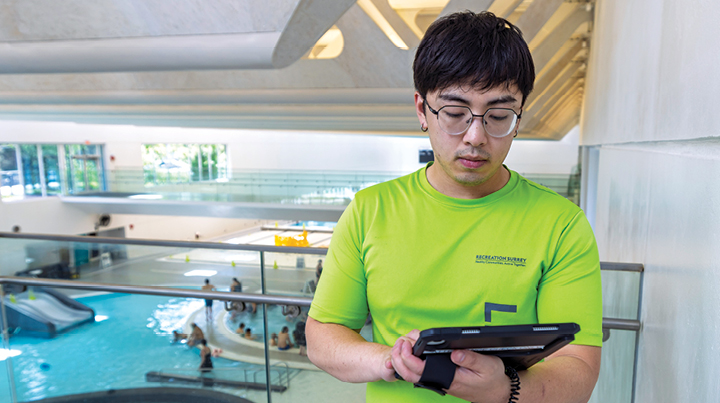
Surrey has also added several new technologies to its chloramine control measures. At the Guildford Recreation Centre, trained pool workers regularly record combined chlorine tests, pool chemistry parameters, air temperature, and humidity levels on touchscreen tablets. Information is uploaded to a tracking system and continually monitored. This technology will be rolled out to other indoor pools in Surrey in future.
“This, along with HVAC monitoring, gives us excellent insight into what’s happening on the ground, and we have the ability to track trends and make adjustments,” says Charlotte Fetterly, occupational hygienist with Surrey.
Now, when temperature and humidity levels exceed certain thresholds, staff will take actions such as turning off water spray features to limit the associated risk of elevated chloramine release. During hotter, humid conditions in the summer months, additional workers are rotated between work both on and off the pool deck. This effectively limits their exposure to chloramines and heat stress.
“We use the dashboard to track such things as incidences of eye irritation and breathing concerns,” shares Michael Mobilio, recreation operations manager with the Guildford Recreation Centre. “This way we can be proactive rather than reactive with our approach to hazard management.”
“Technology continuously evolves and employers should periodically review available technologies to more effectively control chloramine exposures,” states Williams. For example, real-time trichloramine air monitors were recently introduced that may help to warn of hazardous workplace conditions. Some newer pools are installing modern technologies that improve operating efficiency while also better controlling chloramine generation.
Public awareness campaigns
Pool users play a key role in ensuring clean water and air, and both Surrey and Port Coquitlam have launched campaigns on the importance of showering before entering the pool. Elements have included educational posters at facilities, social media posts, informational videos, and multilingual articles on the importance of showering before using pools.
“The most effective way to limit chloramine exposure is by preventing its production in the first place,” says Williams. “This starts with encouraging patrons to shower before entering the pool.”
Pool staff sometimes act as showering ambassadors. “Our staff make showering messaging fun and casual by adjusting it to all ages,” Patterson shares. “We’ve given out word searches and colouring pages to kids and engaged in face-to-face conversations with youth and adults about the importance of pre-swim showers.”
“To reach as many people as possible, we launch showering awareness blitzes at intervals throughout the year and whenever the pool reopens following a maintenance shutdown,” Patterson adds.
Seeing the results
Subsequent to their investments in enhanced chloramine control measures, both municipalities have witnessed a significant decrease in first aid reports relating to eye and respiratory irritation and a reduction to unscheduled pool closures due to combined chlorine exceedances. Workers also report improved satisfaction with the workplace environment.
“Greater awareness of the hazards of chloramines have rippled across Metro Vancouver and beyond, leading to significant industry changes,” says Williams. “I believe the lessons learned from recent incidents have led to a heightened focus on water and air quality in pools.”
Diligent employers are tackling this issue from multiple angles, including educational campaigns, improved design, and enhanced engineering controls. Air quality at those pool facilities and the health and safety of pool workers and patrons are improving as a result of their efforts.
For further information
Visit our Chloramines webpage on worksafebc.com to learn more about controlling chloramines in pools. The page includes the book Chloramines: Safe Work Practices, a useful resource for employers who use chlorine for water treatment.
This information originally appeared in the Summer 2025 issue of WorkSafe Magazine. To read more or to subscribe, visit WorkSafe Magazine.