
Worker struck by falling cylinder during gantry crane installation
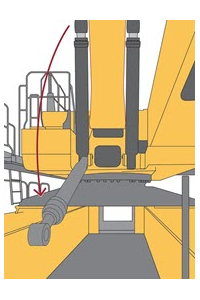
Date of incident: May 2023
Notice of incident number: 2023165700009
Employers: Hydraulics supply & service firm; shipping firm (as prime contractor); barge reload facility; truck transport firm
Incident summary
A gantry-type crane was being assembled on a moored barge with the use of a mobile crane also located on the barge. Two workers were installing hydraulic lines for the gantry crane. Other workers were using the mobile crane to lower hydraulic cylinders into place and attach them to pins on the gantry crane boom. The workers attaching the cylinders ran into problems and decided to stop their work process to reassess it. As part of the stoppage, they began to lower the boom of the gantry crane. A large hydraulic cylinder attached to the housing of the gantry crane broke free from its rigging and struck one of the two hydraulics workers. The worker sustained serious injuries.
Investigation conclusions
Cause
- Worker in lift zone was struck by falling cylinder. One of the two hydraulics workers was positioned under the gantry crane’s platform, also known as its “doghouse.” One of the gantry crane cylinders above was slightly extended. When the boom was lowered as part of stopping the work process, it contacted the cylinder and pushed it down, which broke the come-along holding it in place. The cylinder fell and struck the hydraulics worker, who was just emerging from beneath the doghouse.
Contributing factors
- Failure to coordinate work at multi-employer site.
- The shipping firm that subcontracted the barge reload facility, the truck transport firm, and the hydraulics supply firm for the work of assembling the gantry crane had only verbal contracts with those firms. None of the subcontracted firms had been assigned prime contractor responsibilities; therefore, those obligations defaulted to the shipping firm. The shipping firm was to coordinate the firms’ work activities at the site and have a system in place to ensure that the activities complied with occupational safety requirements, but it did not do so.
- The lack of coordination of work activities on the barge was a factor in the two hydraulics workers being permitted to work in a hazardous area under the gantry crane’s boom. Further, no emergency response procedures were in place at the site.
- Lack of hazard identification.
- The shipping firm did not identify and address hazards or assess risks at the multi-employer workplace.
- Neither the barge reload facility nor the truck transport firm identified and addressed the hazard of a crane being operated at the same time and in the same location as other work activity, or assessed the related risks. The barge reload facility and the truck transport firm were responsible for organizing and controlling the work of anyone on the barge who was not involved in operating the crane to ensure the crane operation could be carried out safely.
- The shipping firm did not put in place a system to ensure the work activities complied with the Workers Compensation Act and the Occupational Health and Safety Regulation, which meant that the firm had no way of monitoring whether its subcontractors were carrying out hazard identification for the project’s work activities.
-
Lack of safe work procedures.
- The shipping firm had no documentation to show that safe work procedures (SWPs) had been developed and adopted for installing the gantry crane on the barge.
- The barge reload facility and the truck transport firm had not provided their workers with SWPs for other subcontractors to work with them on the barge, specifically if their workers were operating a crane. The two hydraulics workers boarded the barge and were working on hydraulic lines directly below an operating crane.
- The hydraulics supply firm did not have SWPs for the work the two hydraulics workers had to carry out on the barge.
-
Lack of supervision.
- The shipping firm did not ensure that workers on its project would receive adequate supervision. When the two hydraulics workers arrived on the barge, they asked another worker on the barge, who was not in a supervisory role, whether it was safe to work under the gantry crane. They were told it was.
- The truck transport firm did not provide the supervisor with an operational plan. Therefore, the supervisor was unaware that the two hydraulics workers were working directly below an operating crane. As a result, he was unable to ensure the workers’ health and safety at the site.