
Worker seriously injured in fall when tree broke at base
Date of incident: April 2020
Notice of incident number: 2020188180004
Employer: Tree services provider
Incident summary
A tree services crew was removing several trees from a private backyard. To remove the top section and limbs higher up in a dead alder tree, an arborist climbed to the midsection of the tree, where he secured a rigging system consisting of a pulley with a rope fed through it. One end of the rope would be tied to the section of the tree that was being cut, and the other end would be held by a ground worker lowering the cut-off section. The arborist continued climbing to approximately 12.2 m (40 ft.) above ground and tied the rope to the top section of the tree, which he then cut off. The top section fell to the full reach of the rope while held in the pulley and did not hit the ground. The base of the tree broke, and the arborist fell with the tree to the ground. He sustained serious injuries.
Investigation conclusions
Cause
- Shock loading caused brittle wood inside dead alder tree to break. The tree broke and fell because it was unable to withstand the shock load created when the top of the tree was cut off and dropped, pulling down on the rigging system attached to the tree’s midsection.
Contributing factors
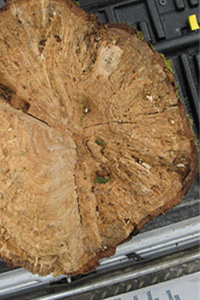
- Inadequate supervision. The employer did not ensure that jobsite safety analyses were being properly completed. The employer also did not provide adequate oversight of its workers to ensure that they conducted a thorough assessment of dead trees. An increment borer or a chainsaw could have been used to assess whether the dead alder tree was safe to climb. Instead, the workers conducted a visual inspection of the tree, and the arborist checked the hardness of the wood with a foot spur approximately every 1.8 m (6 ft.). The assessment did not identify the fact that although a band of hard wood about 2.5 cm (1 in.) in from the bark encircled the tree, most of the wood within the tree was decayed and brittle.
- Lack of safe work procedures and training. The employer did not have written safe work procedures for the work activities taking place. The employer also did not provide training in procedures specific to tree assessment and the tasks for removing trees. Proper instruction and training would likely have prevented this incident.