
Worker rolling out roofing membrane fell 9 m and died
Date of incident: February 2022
Notice of incident number: 2022189780001
Employers: Roofing companies (2); educational society
Incident summary
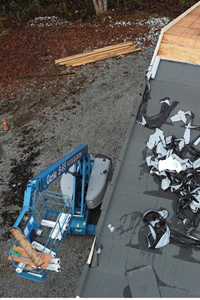
Two workers were rolling out and securing waterproof membrane on the roof of a newly constructed storage building. The roof had a 4:12 slope. One of the workers fell from the edge of the roof at an area that was approximately 9.1 m (30 ft.) in height. The worker landed on the ground below. He later succumbed to his injuries.
The workers were employees of a roofing firm that had been subcontracted by another firm to help roof a newly constructed outbuilding on a prime contractor’s property.
Investigation conclusions
Cause
-
Worker without fall protection system fell from height.
- Investigators believe that just prior to the incident, the worker was walking backward as he rolled out the roofing material. The worker was not using a fall arrest system and fell over the edge of the roof to the ground.
- Both the employer’s health and safety manual and a site-specific fall protection plan provided by the subcontracting firm noted that a fall arrest system was required for the type of roofing work underway on the incident day. At the time of the incident, neither the worker nor his co-worker was wearing a fall arrest system, nor was there evidence to suggest that any fall arrest system had been set up that day.
Contributing factors
- Inadequate training.
- The worker and his co-worker were considered new workers at the time of the incident. The employer did not provide either of the two new workers any formal training or orientation. At the time of the incident, the co-worker was acting as supervisor at the worksite without adequate training or experience to understand his responsibilities in that role.
- The worker and his co-worker were not provided with adequate fall protection training to safely perform their work duties on the roof. The worker operated an elevating work platform (boom lift) that was on site to access the roof and raise rolls of material onto it. The worker was not trained to use the equipment.
- Inadequate supervision. The employer did not provide adequate supervision to its workers. The co-worker, a new worker, was acting as supervisor but (as mentioned) was not adequately trained to supervise the worker, a new and young worker. The employer put the co-worker in a supervisory role without providing him with adequate information, instruction, or training to understand the responsibilities he had as a supervisor on the day of the incident. The employer did not ensure that the site-specific fall protection plan that was provided by the subcontracting firm was implemented by its workers at the worksite.
- Hazards were not controlled.
- The subcontracting firm had supplied the employer with a fall protection plan that lacked detail and instruction. The plan that was provided was not followed on the day of the incident nor was any other plan created by the employer. The investigation determined that the worker and his co-worker were conducting roofing activities without the required fall arrest systems that were listed on the fall protection plan.
- The employer had little to do with the planning of the work that was being conducted for the subcontracting firm. The employer was aware of the size and scope of the project but failed to ensure the two workers were trained and equipped to identify and mitigate the fall hazards and associated risks they were subjected to.
- Additionally, the prime contractor did not ensure a system was in place to mitigate hazards such as the fall hazard the workers were exposed to at its multi-employer workplace.
- Inadequate prime contractor and site safety coordination.
- The owner of the property did not designate a prime contractor for the project of constructing the storage building on its site. Therefore, the property owner was the prime contractor, with the attendant responsibilities for coordinating health and safety at the site. It failed to ensure that hazards were addressed during the roofing work activities by having a system or process in place to ensure compliance with Part 2 of the Workers Compensation Act and with the regulations pertaining to the workplace.
- The workers were working at heights greater than 3 m (10 ft.) without an adequate fall protection system, a high-risk safety violation. The prime contractor did not review or even have knowledge of the fall protection plan as a qualified prime contractor ought to. The workplace lacked a posted site drawing with information including a first aid location and emergency plan.
- The prime contractor failed to coordinate the health and safety of the workers at its worksite by failing to appoint a qualified site safety coordinator or assign prime contractor duties to a qualified firm.
2021-04-22 20:42:33