
Worker fatally injured by runaway compressor
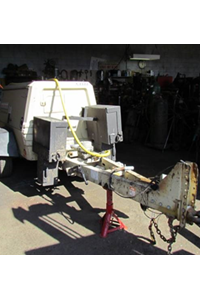
Date of incident: September 2019
Notice of incident number: 2019186390018
Employer: Municipal government
Incident summary
Two workers were travelling between worksites in an employer-provided dump truck (a 1-ton truck with an installed dump box) that was towing a trailer-mounted air compressor unit (the compressor). The compressor had a working weight (with fuel) of 1054 kg. When the dump truck drove up a steep hill, it lost power and stalled before the crest of the hill. Following several unsuccessful attempts to complete the ascent and a collision with a parked passenger vehicle, the workers disconnected the compressor in order to move it to the side of the road. Using their strength and body weight to control the compressor, both workers manoeuvred the compressor until the jack stand wheel near the compressor tongue was positioned against the curb. While the jack stand wheel was resting against the curb, one of the workers, standing on the downhill side near the front of the compressor, attempted to reposition the tongue of the compressor. The compressor began to roll down the hill, and the worker attempted to stop it with his body weight. The worker sustained fatal injuries.
Cause
- Failure to secure compressor. After the compressor was disconnected from the dump truck and relocated to the curb, it was not adequately secured against inadvertent movement on an incline by application of the installed parking brake or use of a wheel chock. Prior to the repositioning attempt, the sole means of securement against movement was the jack stand wheel resting against the curb. As the worker repositioned the tongue of the compressor, the jack stand wheel moved away from the curb. Without the resistance from the curb, the compressor was able to begin to roll down the hill, with rapidly increasing speed and momentum.
Contributing factors
- Improper position for task. During an attempt to relocate the tongue of the compressor, the worker positioned himself in the downhill pathway of the compressor. As the compressor rotated and the jack stand wheel moved away from the curb, the compressor began to roll.
- Inadequate assessment of risk. Given the weight of the compressor and its rapid increase in momentum, the worker did not have the ability to stop the compressor once it began to move.
- Failure to follow procedures. The compressor was disconnected from the dump truck while it was on a steep incline. This act conflicted with the employer’s established procedures, which state that trailers are not to be disconnected on a hill. Following the collision with a parked vehicle, the activity should have been stopped, the collision scene preserved, and the supervisor notified. The employer’s post-collision procedure states that only actions required to address an immediately hazardous or unsafe condition are acceptable.
- Situational strain. Following the earlier collision with the parked passenger vehicle, the difficulties manoeuvring the dump truck continued. The workers began to work largely independently.
- Improper maintenance and repair. The gear shift knob in the dump truck had been replaced during a service appointment approximately two and a half years earlier. The shift pattern displayed on the replacement gear shift knob did not coincide with the shift pattern of the dump truck’s transmission. A driver not aware of the issue and not familiar with the vehicle would be likely to experience problems related to the incorrect selection of gears, such as stalling or unintended directional movement, as was the case in this incident.