
Worker drowned when fabric webbing panel broke away from support system
Date of incident: June 2020
Notice of incident number: 2020165830024
Employer: Ferry service company
Incident summary
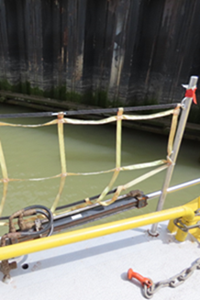
A worker was alone on the embarkation ramp of a ferry vessel that was docked at a maintenance facility. The worker was using a pike pole (a long pole with a sharp point and hook) to retrieve an item floating in the water. The worker leaned onto and over a panel of fabric webbing, holding the pike pole. The fabric webbing panel broke away from its support system, and the worker fell into the water and drowned.
Investigation conclusions
Cause
- Worker not wearing PFD fell into water. The worker was alone on the embarkation ramp of the ferry, without a personal flotation device (PFD), while leaning onto and over the fabric webbing panel at the edge of the ramp.
Contributing factors
- Non-compliant guardrail. The employer had replaced two steel guardrails on the edge of the embarkation ramp with fabric webbing panels. The fabric webbing panels, attached with zip ties and bungee cords between an aluminum stanchion on one side and an aluminum guardrail on the other side, could not withstand pressure applied by a person who might lean onto them. The employer had a duty to ensure adequate guardrails were installed to prevent workers from falling into the dangerous area (the water) below.
- Inadequate supervision. The employer did not ensure that workers’ work methods were checked, nor that assigned safety topics were discussed at toolbox meetings and the meetings were documented. Site inspections, hazard analyses, and risk assessments were not conducted, and work permits were not reviewed. The employer did not ensure that workers wore a PFD while working within 2 m (6.5 ft.) of the edge of the embarkation ramp as required by the employer’s safe work procedures and the Occupational Health and Safety Regulation.
- Lack of safety oversight. The employer did not have controls in place to prevent the steel guardrails from being replaced with guardrails that did not meet the specifications of engineered drawings or the requirements of the Regulation. This allowed the creation of a hazard. The employer also did not have a check-in and check-out procedure so was not aware that the worker was missing until later that night. Although a security system recorded the movement of workers entering and exiting the facility, the employer did not use this system to ensure all workers had left the worksite after their shift.
- Lack of safe work procedure. The employer did not have a safe work procedure in place for the retrieval of objects that have fallen into the water and did not communicate to workers the hazards of retrieving items from the water.
- Lack of safety inspections and hazard identification. A new embarkation ramp had been installed on the ferry. The ferry was not inspected, including the embarkation ramp and the webbing panels that replaced the guardrails, to ensure that regulatory requirements were met. Also, for operational reasons, a gangway ramp was installed onto the embarkation ramp for workers to embark the vessel, but the section of the gangway ramp that rested on the embarkation ramp was not adequately guarded, and no signage was in place to notify workers of the hazard. No assessment was conducted to identify hazards, including identifying the water below as a dangerous area.
- Lack of guarding. The ferry had no guard in place to stop a worker from accessing the edges of the embarkation ramp, which allowed access to the dangerous area below. The employer was required to ensure that adequate guarding, such as a barrier, was installed to prevent anyone from entering within 2 m (6.5 ft.) of the edge of the embarkation ramp.
2021-04-22 20:42:33