
Worker burned when electrical fault occurred during voltage test
Date of incident: September 2019
Notice of incident number: 2019158880008
Employer: Sole proprietor (electrician)
Incident summary
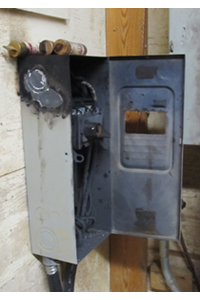
An electrician was holding a clamp-on meter to test the voltage on the line (power‑source) side of a 600 V switch prior to the commissioning of new refrigeration equipment. When the worker touched the metal probe tips to the top part of the switch, an electrical fault occurred, resulting in an arc flash followed by an arc blast. The worker sustained serious burn injuries.
Cause
- Phase-to-phase short-circuit occurred, causing arc flash and arc blast. The intended voltage test by the worker inadvertently caused arcing between two phase conductors on the line side of a 600 V three-phase switch. When the probe tips came into contact with the energized top portion of the switch, it triggered a fault in the meter, resulting in an electrical short‑circuit across two phases of the power supply’s three phases. The phase-to-phase short‑circuit created the arc flash and arc blast that destroyed the switch.
Contributing factors
- Meter was incorrectly configured. The selector on the meter was ranged for 750 V, the correct voltage for the system being tested. However, the test leads were in the resistance measurement jacks (on the right side of the meter) rather than the voltage measurement jacks (on the left side of the meter). When the probes were connected across the two energized conductors, a large in-rush of current flowed through the meter and the energized conductors, triggering an arc flash and an arc blast. Although the meter that the worker used was still acceptable for use, it was an older design. Newer meters do not require a change to the configuration of the test leads in the same way as the meter that was involved in this incident. Although a fault can still occur when a new meter is used, the simple oversight of forgetting to change the position of the leads cannot.
- Personal protective equipment was not used. The worker was not wearing appropriate personal protective equipment (PPE) for the hazards he was exposed to. If the worker had been wearing adequate PPE, his injuries from the radiant energy might not have been as serious.
data-bs-keyboard="true">
2021-04-22 20:42:33