
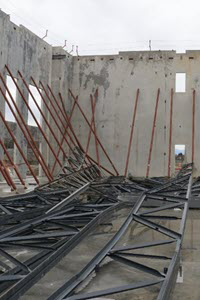
Structural steel components of building under construction partially collapsed
Date of incident: March 2022
Notice of incident number: 2022171890005
Employers: Real estate development company (prime contractor); steel construction company (2; one subcontracted by the other)
Incident summary
At a new building construction site, which consisted of pre-fabricated concrete tilt-up panels and structural steel components, a structural steel erection crew had partially erected structural steel components, including columns, beams, and open web steel joists (OWSJs). Some time after the conclusion of one workday and before the beginning of the next workday, the structural steel in a corner of the building partially collapsed. No workers were injured.
Investigation conclusions
Cause
- Lack of fastening and lack of bracing caused open web steel joists to collapse. The ends of the OWSJs were placed into panel pockets in the northeast corner of the new building and were not fastened. The structural stability of the newly erected structural steel therefore relied on the bearing of the unfastened OWSJ ends in the panel pockets; the ends were only 6.4 cm (2½ in.) deep in the panel pockets. Forces such as wind, ground vibration, and the inherent stresses in the partially erected structural steel were likely exerted on the structure, resulting in the unfastened OWSJs being pulled away from the panel pockets on the east wall, which led to the partial collapse of the structural steel components. In addition, permanent bracing was not installed at two locations. Had permanent bracing been in place at these locations, the structure likely would have been more stable.
Contributing factors
- Lack of hazard identification and risk assessment. The employer of the structural steel erection crew did not carry out a hazard identification and risk assessment of leaving the OWSJ ends unfastened in the east wall panel pockets at the end of the workday. Had the employer identified the risk of the forces acting on the unfastened OWSJ ends, the crew could have implemented measures to mitigate the risk.
- Inadequate adherence to erection procedures. The erection procedures recommended tack welding (a temporary welding process) the OWSJ ends to the east wall panel pockets, but this recommendation was not followed. Had the OWSJ ends been tack welded, the structure likely would have been more stable.
- Inadequate erection procedures. The erection procedures used by the crew contained several deficiencies. The procedures were not clear and were not updated by a professional engineer. Clear and appropriate instructions by a professional engineer detailing safe erection procedures should have been used.
- Inadequate supervision. The employer had a responsibility to provide its workers with the supervision necessary to ensure the health and safety of those workers. The employer did not ensure that the structural steel erection procedures were adhered to during the installation process.
- Inadequate health and safety coordination. The prime contractor had a responsibility to ensure compliance with the Occupational Health and Safety Regulation. The prime contractor did not have an effective system in place to ensure that the erection procedures used by the crew complied with the Regulation, nor did the prime contractor have a system in place to ensure that the workers followed the erection procedures.
data-bs-keyboard="true">
2021-04-22 20:42:33