
Rockfall struck equipment at remote construction site
Date of incident: May 2020
Notice of incident number: 2020166950015
Employers: Construction and engineering company; rock-scaling and slope-stabilization company; geotechnical engineering company
Incident summary
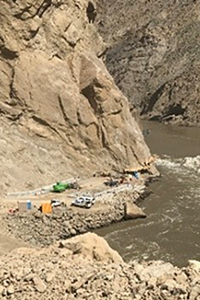
A natural rockfall event occurred during the off‑shift hours at a remote construction site where work was underway to prepare the site for the installation of a mechanical fish transport system. Rock‑scaling operations had been completed, and a lock-block fish ladder and a walkway around the cliff face above the river were being constructed. Two rocks, each 1 m in diameter, fell from a rock face. One of the rocks struck a grout mixer located below the rock face. The event was unwitnessed, and no injuries were reported.
Investigation conclusions
Cause
- Release of conglomerate rock from cliff face. A weak mud layer moistened by water seepage within the rock formation eroded to the point where it released two rocks, each 1 m in diameter. The two rocks rolled down the cliff and onto the work area. The incident occurred between the two work shifts, with no workers present.
Contributing factors
- Unknown mud layer, rocks, and water seepage in cliff above work area. Neither the construction and engineering company nor the geotechnical engineering company knew about the layer of mud due to the recent dry weather conditions, or about the two rocks in the mud layer. After the incident, a source of water was discovered in a gully situated above the point of release. During the spring thaw, water from higher elevations had travelled within the rock formation and accumulated at the gully. The water then flowed along the mud layer to the rock face, where it moistened and eroded the area where the two rocks were embedded. Due to the size of the cliff, it was not possible to anticipate areas that could become unstable as a result of water seepage within the rock formation.
- Long-term control measures not in place. Construction of an attenuator net and lock-block retaining wall (to anchor the net and to contain rocks falling down the slope) had not yet begun. At the time of the incident, the risk of falling rocks was determined to be acceptable (low) as the rock-scaling operations had been completed and the companies conducted daily assessments and inspections of the worksite looking for signs of rockfall hazards. Construction was focused on the work that needed to be completed before water levels rose higher and impeded access to the walkway and the fish ladder.