
Recovery boiler worker seriously injured by molten smelt
Date of incident: March 2023
Notice of incident number: 2023154970007
Employer: Pulp and paper mill
Incident summary
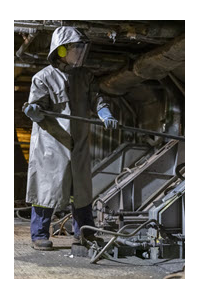
A worker at a pulp mill was attempting to clean out a smelt spout on a recovery boiler with a rodding tool (a long rod) when an explosion inside the boiler ejected molten smelt out of the spout onto him. The worker sustained serious injuries.
Investigation conclusions
Cause
- Worker struck by molten smelt from recovery boiler. A recovery boiler reclaims the inorganic chemicals used in the kraft pulping process and captures the energy value in the organic portion of the kraft liquor as steam and electrical power for use in the pulp mill. Molten smelt was ejected from the recovery boiler due to a steam explosion that occurred because smelt contacted wet black liquor. After the worker was struck, further steam explosions ejected more smelt from the boiler.
Contributing factors
- Manual dampers for primary air ports seized. Wet black liquor accumulated on the wall of the recovery boiler instead of combusting in the air stream above the boiler’s smelt bed. Manual dampers for the primary air ports on the boiler (openings that allow air needed for the combustion process to enter the boiler) had not been properly maintained. A lack of regular maintenance led to poorly functioning dampers that were difficult to control. Consequently, it was challenging to optimize air flow within the boiler when workers were required to respond to poor combustion and smelt bed levels.
- Lack of communication regarding liquor gun nozzle size changes. Liquor guns on the boiler direct the kraft liquor into the boiler’s combustion chamber via spray nozzles. The recovery boiler operators had changed the nozzles’ orifice size from 28/32nds to 32/32nds in an effort to control known black liquor combustion issues. A supervisor confirmed that the operators had the authority to make changes to the liquor guns. However, the changes were not being communicated to supervisors nor recorded in operators’ logs. Consequently, management was not included in discussion about the changes and their potential effects on liquor pressure within the boiler and on the stability of the recovery boiler process.
- Inappropriate response to upset condition. The worker responded to a situation that he thought was a plugged smelt spout, but he was not aware of the actual conditions inside the recovery boiler — namely, that there was uncombusted black liquor on the wall of the boiler — and therefore could not respond effectively and safely. The worker’s actions were based on inadequate information gained merely by looking at the mouths of the air ports and smelt spouts. The lack of a bed camera meant that the worker could not see the conditions in the combustion chamber of the recovery boiler.
- Ineffective safeguarding against ejected molten smelt. The smelt spout had no guarding corresponding to industry best practices. Such guarding would have acted as a barrier between the worker and the mouth of the smelt spout.
- Lack of adequate personal protective equipment. The worker was not wearing adequate protective clothing, which would have served as a barrier to the ejected smelt.
- Access to emergency washing facilities impeded. The worker could not access the nearest emergency washing facility because molten smelt was still being ejected from the boiler, which made crossing the smelt deck to the shower hazardous. He was forced to seek an alternate emergency washing facility, thus prolonging his exposure to the molten smelt on his body and the heat from his partially burning coveralls.
- Inadequate process safety and management of change oversight.
- Process safety considerations for the recovery boiler recognized certain critical controls for the risk of a smelt ejection, such as frequent observation of the boiler’s smelt bed by operators and adjusting air flow to maintain combustion. However, the employer did not install a bed camera in the boiler to enable workers to accurately gauge conditions inside, nor did it ensure that the boiler’s dampers were operable so that air flow could be fine-tuned.
- As well, changes in operating procedures were exempt from the employer’s management of change policy — yet the key risk controls for smelt ejections and blackouts constituted operating procedures. Therefore, operators were left to make changes to the boiler’s liquor gun nozzles in an effort to remedy problems with combustion in the boiler, and were not required to inform management that they had done so.
data-bs-keyboard="true">
2021-04-22 20:42:33