
Patient fired gun at police officers and paramedics
Date of incident: October 2022
Notice of incident number: 2022192850020
Employers: Ambulance service, police service
Incident summary
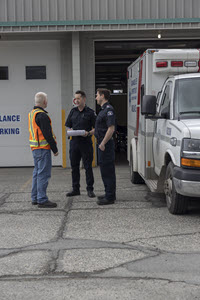
After being involved in a motor vehicle incident, a person was attended to by police and paramedics and then transported to hospital via ambulance. In his possession was a personal bag that likely contained a firearm. The patient was treated for injuries, left the hospital, and then fell into a river nearby. He had his bag with him. The police officers who transported him back to the hospital believed the patient may have a head injury. The patient was transferred via ambulance to a second hospital for further medical follow-up to rule out possible head trauma. He remained focused on his bag in the ambulance. The patient left the second hospital wrapped in a hospital blanket and carrying his bag. He walked to the adjacent ambulance station and confronted the paramedics, asking several times to come inside. In an attempt to de-escalate the patient, three paramedics went outside to talk with him, and a fourth paramedic called the police from inside the station. When two police officers arrived outside the station, they interacted with the patient briefly before he dropped the blanket and positioned himself in a fighting stance holding the firearm. The patient shot three to five bullets at the police officers and paramedics. No workers were physically injured.
Investigation conclusions
Cause
- Patient discharged firearm at workers. The patient’s motor vehicle incident was reported to the police by a person who knew the patient and who cautioned the police that the patient had a history of challenges and may have a weapon to protect himself — specifically a firearm. The patient had the firearm with him throughout a series of interactions with police officers, paramedics who transported the patient via ambulance, staff at two hospitals, and then the four paramedics and two police officers at the nearby ambulance station.
Contributing factors
- Failure to search patient’s belongings. Due to the information the police had received about the patient possibly having a firearm, the police officers searched the patient after he was extricated from his vehicle; however, they did not search the personal bag that was with him. The investigation determined that the firearm was most likely stored in the patient’s bag. The police officers who picked up the patient at the river did not search the patient or his bag before returning him to the first hospital. The ambulance service’s procedures do not allow paramedics to search patients or their belongings. Although the patient’s behaviours warranted both a medical assessment and control by the police — as he was a hazard to himself, workers, and the public — his belongings were not searched, and as a result his firearm was not found.
- Inadequate communication. At the location of the patient’s motor vehicle incident, the police officers did not share pertinent information with the paramedics, including the possibility of the patient having a firearm, his true identity (the patient provided a false name to the paramedics and both hospitals), and his history of challenges. The first team of paramedics discovered some concerns through their interactions with the patient, including behaviour that warranted a medical assessment and hearing the police officers refer to him by a name that was different from the one the patient had told the paramedics. If the police officers had told the paramedics the background information known about the patient, it could have led the paramedics to ensure their safety by having the police officers conduct a full search of the patient and his bag.
- Failure to adequately train on safe work procedure. When transporting patients, paramedics must handle a patient’s personal effects. The ambulance service has a procedure that requires a patient’s personal effects to be itemized and reported on the patient care report. However, the paramedics involved in the incident did not do this. There is no evidence to indicate that they had received training on the procedure.
- Inadequate safety features of ambulance station. Ambulance stations are available to the public in case of emergency medical situations. The ambulance station where the incident occurred did not have an intercom system, any video cameras, or adequate window coverings — all of which would have provided additional safety and security to the paramedics inside the station for situations where they had to interact with patients or the public.