
Excavator’s track struck, pinned worker guiding suspended load
Date of incident: April 2022
Notice of incident number: 2022190510004
Employer: Industrial construction firm
Incident summary
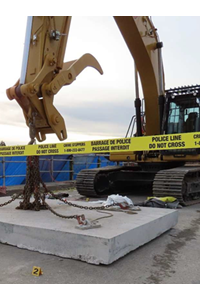
Workers on a bridge rehabilitation project were using an excavator to move a cut concrete section of the bridge deck. The panel weighed about 5 625 kg (12,400 lb.). It was attached to the excavator’s boom with four-point rigging. Two workers, a carpenter and a concrete cutter, were walking alongside the concrete panel and stabilizing it by hand as the excavator travelled along the bridge, when the carpenter was crushed by the excavator’s track. The carpenter was seriously injured.
Investigation conclusions
Cause
- Worker struck and pinned by excavator track. The carpenter was walking next to the heavy load to prevent it from swinging. When the concrete panel swung, the carpenter moved between the load and the track of the excavator to stabilize it. The carpenter stopped momentarily and at that point the oncoming excavator track struck and pinned him.
Contributing factors
- Safe work procedures for tag line and blind spot not followed. The carpenter was positioned too close to the excavator’s track while the excavator was moving because he was using his hands to manoeuvre the swinging bridge deck panel instead of using a tag line. The carpenter had to be within arm’s reach of the suspended panel, which put him between the moving track of the excavator and the suspended load. The carpenter was positioned with limited space to move around or get out of the way of the excavator and also in the blind spot of the foreman who was operating the excavator.
- Failure to use spotter for moving suspended loads. A spotter was not being used to coordinate the movements of the excavator with its suspended load. The workers relied on radio communications, which they stated were ineffective due to the noise created by the work in the vicinity, including concrete cutting and a vacuum truck. The workers relied on hand signals to coordinate the movement and lifting activities of the excavator when radio was unreliable. The employer had a safe work practice (SWP) that called for a spotter to be used when a work area is congested, which was not followed.
- Insufficient supervision. The foreman was the supervisor for the task of removing the bridge deck panels and was also the excavator operator. A supervisor should ensure that workers are made aware of all known or reasonably foreseeable health or safety hazards in the area where they work. The foreman’s ability to supervise the workers was limited because he was also operating the excavator, which takes focus. The workers had safety meetings about the hazards of working around mobile equipment, but new safety hazards, like obstacles, that appeared as the workplace changed were not taken into account. At the time of the incident, safe work procedures were not being followed. The site superintendent was responsible for ensuring that the SWP was being followed by workers.
- Failure to coordinate worksite. A work area must be arranged to allow the safe movement of people, equipment, and materials. Multiple work processes on the bridge deck were taking place at the same time with separate goals and a lack of coordination. The panel removal work became more efficient as the workers became practised at it. The concrete cutting maintained its initial pace, which was slower than the panel removal. Workers, tools, generators, and vehicles were grouped in the same area, causing congestion and noise at the worksite. This congestion led to the excavator having to manoeuvre around the vacuum truck with the suspended panel. The path of the excavator was angled toward the area the carpenter was working in, bringing the excavator and the carpenter closer than if the excavator hadn’t had to manoeuvre around the vacuum truck. Effective planning of the worksite would have kept the work processes separate from each other and the excavator would not have had to manoeuvre around obstacles. As the prime contractor, the employer was responsible for coordinating the activities of all the workers at the site.
- Failure to follow panel removal work procedures. The employer’s engineered procedure for deck panel removal indicated that the excavator could walk the suspended panels the length of three bays on the bridge, that is, 21 m (69 ft.). Usually, the excavator loaded the panels onto a trailer which was then taken to a storage area at the south end of the bridge. The trailer became unavailable, and the foreman made the decision to walk the panels to the storage location with the excavator, a distance of approximately 198 m (650 ft.). Approval to modify the engineered work procedure was not obtained. The workers had signed off on a work plan hazard analysis form that indicated that a tag line was to be used to guide a suspended load, but the form was not adhered to. The tag line was attached to the panel, but workers used their hands to manoeuvre the load, bringing them much closer than necessary to the hazards of the excavator’s tracks and the suspended load.
data-bs-keyboard="true">
2021-04-22 20:42:33