
Crane’s block fell 29 storeys, narrowly missing workers on ground
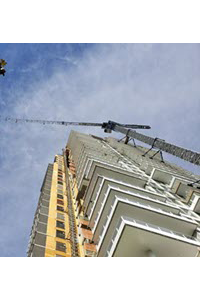
Date of incident: September 2021
Notice of incident number: 2021180940016
Employer: Concrete forming firm
Incident summary
At a highrise construction site, a tower crane was being used to move workers and materials around the workplace. At the end of the workday, the crane was being shut down when the primary load block and the ancillary block detached and fell 29 storeys to the ground. Workers on the ground were close to where the crane parts landed. The incident was a near miss and no workers or other persons at or near the workplace were injured.
Investigation conclusions
Cause
- Primary block hit jib, causing load line to break. As the primary block was being raised, it contacted the jib of the crane, causing the load line to break. When the load line broke there was nothing restraining the primary block and it fell to the ground. The ancillary block stored on the underside of the jib was also released at this time, and also fell to the ground approximately ¾ of a second after the primary block. The impact of the blocks caused dust and debris to be scattered across an area of at least 22 m (72 ft.) from the impact location of the primary block.
Contributing factors
- Load line was raised too quickly. The crane operator was in the process of shutting down the crane, which included running the primary block up near the top of the load line where it would be stowed for the night. The operator began lifting the primary block from ground level in first gear and as it rose, transitioned to third gear, reaching the crane’s maximum speed. The operator was reliant on the engineering control of an upper limit device (see next bullet) to stop the upward movement of the load line and primary block. As the primary block neared the point where the upper limit device would normally be engaged, the operator realized the primary block was moving too fast and placed the crane’s drive into neutral. But by then it was too late, and the primary block continued past the upper limit device due to momentum. By the time the operator considered hitting the emergency-stop button, the primary block had already contacted the underside of the jib.
- Safety controls on crane were ineffective.
- The crane had an engineering control that was pre-set when the crane was erected to limit the load line’s upward movement. The upper limit device was set to the manufacturer’s specifications for the highest allowable position. Another engineering control, the speed change limit device, also set during the erection process, regulates predetermined maximum speeds of the crane’s hoist in each gear when lifting the primary block. The crane could be operated in a way that exceeded the engineering controls. The speed at which the hoist was operating allowed the block to travel through the upper limit device, and the block’s built-up momentum allowed it to continue to climb until it contacted the underside of the jib.
- If the employer that supplied the crane and its operator had implemented a specific safe work procedure for end-of-day crane operations, the SWP could have specified a maximum gear or hoist speed at which the primary block was to be hoisted. In addition, the upper limit device could have been set at a lower position, according to the manufacturer’s specifications. Having the limit device in a lower position might have stopped the hoisting of the primary block prior to it making contact with the underside of the jib.
data-bs-keyboard="true">
2021-04-22 20:42:33