
Workers injured when wire rope of hoist broke
Date of incident: October 2019
Notice of incident number: 2019166520013
Employers: Manufacturing company; crane (hoist) inspection company
Incident summary
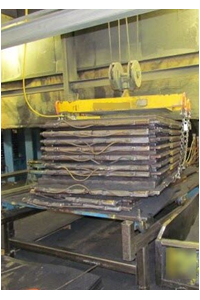
Two workers were making rubber mats at a manufacturing facility. After one of the workers finished shovelling rubber crumbs into a mould near the bottom of a stack of moulds suspended by a monorail hoist, the wire rope of the hoist broke. Both of the workers had an arm under the mould when the wire rope broke. The total mass of the suspended load was 7034 kg. One worker sustained minor injuries; the other worker was seriously injured.
Cause
- Excessive wear of wire rope. Based on an independent forensic examination, the investigation concluded that the wire rope broke due to a combination of wire wear and fatigue cracking. Wear on the wire rope’s external wire surfaces was caused by the rope being pulled sideways by the position of the winding drum, causing contact on the sides and sharp upper edge of the sheave. The hoist had been installed approximately 10 months before the incident, and the hoist’s winding drum (for spooling the wire rope) was longer than the one it had replaced. The longer drum created higher rope angles with respect to the sheave block, with the rope at the extreme ends of the drum, which led to high sheave-to-wire contact loads and rapid fatigue cracking.
- Workers permitted to work under a suspended load. The work process involved in making the rubber mats meant that workers were continually reaching under a suspended load. Had a work process been designed to eliminate the need to work under a suspended load, the incident would not have occurred.
Contributing factors
- Inadequate frequency of hoist inspection. The hoist was inspected annually but not according to a required standard. The hoist (a severe service crane) was required to be inspected quarterly by a qualified person. At least one more inspection should have been conducted prior to the incident, which might have identified the excessive wear in the wire rope and prevented this incident from occurring.
- Inadequate pre-use hoist inspection. The manufacturing company was not ensuring a pre-shift inspection of the hoist was conducted as required by the Occupational Health and Safety Regulation. The wire rope was also not being inspected during daily or weekly inspections as required by two applicable standards (CSA standard B167-96 and ANSI/ASME B30.11-2004). Proper inspections likely would have identified the excessive wear in the wire rope and prevented this incident from occurring.
- Hoist inspections not conducted to a required standard. CSA standard B167-16 was being used to conduct the inspection of the hoist. CSA standard B167-16 is not an acceptable standard listed in the Regulation to be used to inspect hoists. The crane inspection company should have asked the manufacturing company which standard it was using for the monorail hoists. Alternatively, the manufacturing company should have communicated to the crane inspection company the standard that it was using for the inspection and maintenance of the hoists.
2021-04-22 20:42:33