
Workers injured by electric shock when telehandler fork contacted power line
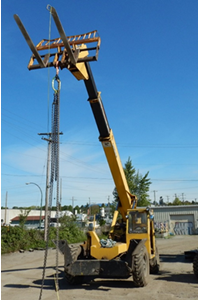
Date of incident: May 2019
Notice of incident number: 2019155500021
Employers: Formwork company; carpentry company; concrete formwork company (prime contractor)
Incident summary
At a storage yard, four workers were preparing to move a section of a tower crane’s counter‑jib to another location on site. They were working underneath a 12.5 kV overhead power line. One of the workers was operating a telehandler forklift with rigging chains attached to its fork frame. The other three workers were rigging the chains to the counter‑jib section. As the forks of the telehandler were raised, one of the forks contacted the power line. A worker grabbed the rigging chains and sustained fatal electric shock injuries. Another worker, who was bent over by the counter‑jib section with his back touching the counter‑jib frame, received an electric shock and was seriously injured.
Investigation conclusions
Cause
- Telehandler fork contacted power line. The tip of a fork on the telehandler breached the limits of approach and made contact with the power line while the workers were attempting to lift the counter‑jib section. As a result, the chain rigging attached to the fork frame became energized.
Contributing factors
- Counter‑jib section stored directly under power line of unknown height and voltage. The counter‑jib section was stored directly under a power line. The prime contractor had not determined the height above grade to the power line, nor the power line’s voltage. The workers moving the counter‑jib section were not aware of the power line’s height or voltage either.
- Telehandler boom extended too far and at too steep an angle. The telehandler was used as a crane to lift the counter‑jib section, contrary to the manufacturer’s instructions. The load charts included with the operating manual did not apply to suspended loads. The length of rigging chains used required a long boom extension at a steep angle so as to reduce the load radius, so that the telehandler could lift the load weight within the specifications of what the prime contractor was using as a load chart. This increase in the boom angle raised the fork tips such that they contacted the power line.
- Inadequate supervision and coordination of work activities. The prime contractor did not ensure safe working procedures for moving and storing equipment at the storage yard. Despite the presence of the power line, no safe work procedures were in place for work activities around power lines, although the prime contractor did have procedures for its commercial construction work. In addition, the workers working around the power line were not aware of the height above grade to the power line, and the prime contractor overestimated the height of the power line that was contacted. All the workers were directly involved in hooking up the rigging to the counter‑jib section. No worker was assigned solely to watch for proximity to the power line in order to avoid contact with it.
Other safety issues
- Risk of telehandler tipping over. The use of the telehandler to lift a suspended load was contrary to the manufacturer’s instructions and could have caused the telehandler to tip over.