
Workers exposed to chemicals during well-cleaning operation
Date of incident: October 2016
Notice of incident number: 2016175160026
Employers: Oil or gas production company; oil or gas field servicing company
Incident summary
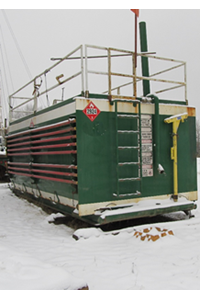
At a wellsite, workers at a service rig were completing oil and gas well-abandonment activities. These activities included removing and installing well control elements and piping (tubing), as well as circulating well fluids. During a pickling operation (a process for removing scale buildup in the well tubing by injecting it with hydrochloric acid, or HCl), a vapour cloud was released. Workers positioned on and around an open-top rig tank were exposed to airborne contaminants, and three of them lost consciousness. A fourth worker sustained exposure and other injuries but did not collapse. The four workers were transported to the hospital for suspected exposure to hydrogen sulfide (H2S ) gas.
Investigation conclusions
Cause
- Workers’ exposure to known industry hazard was not controlled. During the pickling operation, workers were positioned in close proximity to the open-top rig tank. This exposed workers to the only outlet for vapours produced during the circulation of well fluids and by the reaction by-products of pickling. The abandonment program had directed that L-80 tubing be brought from inventory, but inspection of the tubing did not take into account the possibility of cross-contamination of the tubing from its use at a previous sour gas well (a well containing significant levels of H2S gas). Also, a full history of the tubing was not provided to the site management team prior to use. During pickling, the sulphur-containing scale in the L-80 tubing provided a sufficient volume of sulphur to produce H2S in quantities that posed a serious hazard to the health and safety of workers. A component of the vapour released at the rig tank contained H2S, which caused three of the four unprotected workers positioned on the rig tank to lose consciousness.
Contributing factors
- Lack of work procedures and risk assessments. The purpose of pickling the tubing with HCl was to remove scale buildup through a chemically reactive process. It was known in industry that this process can produce H2S if the scale is composed of iron sulfide. The abandonment program provided no warning that such a chemical reaction could occur nor any direction on necessary risk control measures. None of the firms involved had a corporate-level risk assessment or work procedure in place that defined the hazard of H2S during pickling operations. There was no direction or requirement to test the used tubing for the presence of sulphur-containing scale prior to use. Overall, the procedures, risk assessments, and exclusion zones developed by the management crew at the wellsite did not address the exposure of workers to H2S during the pickling operation. The absence of these elements in the collective health and safety management program employed at the workplace overlooked a key process hazard that had the potential for significant worker injury and loss of life.
- Ineffective supervision. The tasks assigned by the abandonment program at the senior management level did not include effective work procedures, hazard assessments, and a risk analysis for the pickling activity. With incomplete information and instruction provided in the abandonment program, supervisor input was less effective, and the risk of H2S reacting with the iron sulfide scale was never addressed.
- Industry-recommended practice was not followed. The Drilling and Completions Committee of Energy Safety Canada (which was created by the merger of Enform Canada and the Oil Sands Safety Association) has developed industry-recommended practices (IRPs) to guide technical operations such as those employed at this worksite. IRP4, Well Testing and Fluid Handling, provides clear guidance on how to reduce the risk to workers during flowback operations into an open-top rig tank. An exclusion zone around the rig tank could have been implemented and enforced to address the work hazards and mitigate the impact of an unexpected occurrence such as the gas release. Furthermore, a plan should have been developed and an assessment conducted to ensure that after circulation of the open-tank system, non-essential workers remained outside the exclusion zone long enough to allow gas and vapours to dissipate and ensure the area was swept with an LEL (lower explosive limit) meter. However, there is no evidence that this element of the IRP was ever considered, and no exclusion zone existed to prevent workers from accessing the hazardous area.
- Normalization of risk. During the first days of operation at the wellsite, high attention was placed on potential H2S exposures from the second-deepest formation, with historical reports showing H2S levels of 1400 ppm. (The ceiling limit for workers in British Columbia is 10 ppm.) Once the wellbore above this formation was capped and readings showed no further H2S emissions, the low-pressure test separator (P-tank) and air supply trailer were removed from service. After this time, there was less regard for a potential exposure to the toxic gas, which can injure and incapacitate a person even at low levels. The open-top rig tank area at the workplace included hazards such as unexpected gas releases, mechanical failure of piping or equipment, and exposure to HCl or other by products of chemical reactions through splashing or vapour release. Only one of the five workers stationed on top of the rig tank was wearing a self-contained breathing apparatus, a personal H2S monitor, acid-resistant gloves, and acid-resistant clothing. The lack of an exclusion zone and the presence of the four unprotected workers in close proximity to a fully protected worker demonstrated diminished vigilance in recognition of and protection against the hazards at the wellsite between the beginning of the abandonment program and the start of the pickling operation. Ultimately, the workers did not regard their positioning over the open-top rig tank during the return flow of HCl in the tubing to be inherently hazardous and so became exposed to a potentially fatal mechanism of injury.