
Worker struck by ice that fell from top of truck trailer
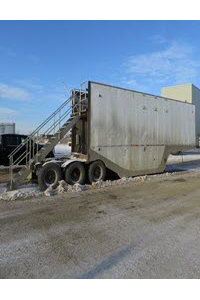
Date of incident: December 2022 Notice of incident number: 2022170090016 Employers: Transportation company; sawmill owner and operator
Incident summary
At a sawmill, a worker driving a transport truck parked away from the tarping station (shown in the photograph). The truck was towing two chip trailers equipped with an electric auto-tarping system. To prepare the trailers for loading with wood chips (fibre), the worker had to remove the tarps. At the passenger side of the first (front) trailer, he pushed the auto-tarping system’s open button, and the tarp lifted from the driver side, like a door on a hinge. While the worker was holding the open button, a chunk of ice fell from the top of the trailer and struck him, causing serious injuries.
Investigation conclusions
Cause
- Failure to clear debris from tops of trailers. The tarping station has stairs leading up to an elevated platform from which drivers can inspect the tops of their trailers and clear any debris, like snow and ice, off the tarps using long-handled tools. At the time of the incident, the tarping station was not used for checking the tops of the trailers to ensure that there were no potential hazards from falling debris before the auto-tarping system was operated.
Contributing factors
- Lack of safe work procedure. The worker’s employer (the transportation company) failed to develop and implement a safe work procedure for the operation of the auto-tarping system, including direction to use the tarping stations at sawmills and at the company’s yard. The purpose of tarping stations is to enable workers to view any potential hazards on the tops of the trailers, so that those hazards may be mitigated before a worker operates the auto-tarping system.
- Failure to follow manufacturer’s instructions. The transportation company failed to ensure that workers were following the auto-tarping system manufacturer’s instructions. The instruction manual and the system controls on the trailers direct workers to check the tops of the trailers for hazards.
- Inadequate hazard identification. By having the auto-tarping system’s controls installed on the passenger side of the trailers — below the location where any debris from the tarps would come down on a driver operating the system — the transportation company failed to identify all hazards with the task of operating the system.
Other health and safety issues
- Failure to report incident to WorkSafeBC. The incident was not reported to WorkSafeBC until three days after it occurred. As the worker was transported to hospital via ambulance, the sawmill owner and the transportation company ought to have known that the worker’s injuries were serious and the incident was therefore immediately reportable to WorkSafeBC.
- Failure to ensure incident scene was not disturbed. The owner of the sawmill was best suited to make sure the scene was not disturbed once the worksite had been made safe after the incident, but did not direct its workers to ensure that the scene was not disturbed. The sawmill owner had a responsibility to preserve the scene of the incident, both to comply with regulatory requirements and so that the transportation company could conduct its own investigation and take any necessary corrective actions. The transportation company made no efforts to have its workers ensure that the scene was not disturbed and did not communicate with the sawmill owner to have sawmill workers secure the scene. As a result, the scene was disturbed when the next driver was asked to move the injured worker’s truck and trailers.