
Worker injured when struck by moving overhead crane bridge
Date of incident: June 2023
Notice of incident number: 2023183430002
Employers: Ironwork company; auctioning company (prime contractor)
Incident summary
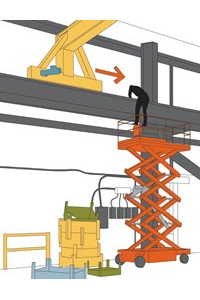
At a manufacturing warehouse, workers were disassembling a freestanding overhead bridge crane system. From an elevated work platform (scissor lift), a worker was removing bolts and splice plates from a rail of the crane system. To access bolts on the opposite side of the rail, the worker climbed onto a guardrail of the scissor lift and leaned over the crane rail. Another worker was assigned to operate the crane to load a previously disassembled component of the crane onto the transport truck. The crane operator moved a crane bridge in the direction of the worker who was leaning over the rail. The bridge struck the worker, pinning him against a structural beam and causing serious injuries.
Investigation conclusions
Cause
- Crane operator not aware of worker’s elevated position during disassembly of crane system. The worker who moved the crane bridge was not aware of the elevated worker’s location.
Contributing factors
- Inadequate hazard identification and risk assessment. The worker’s employer (the ironwork company) did not identify the hazards related to keeping the crane energized and using the bridges to move and load equipment while the crane was being disassembled in one area of the shop, as well as working at heights. If the employer had identified the hazards, the risks could have been mitigated by putting appropriate controls in place, including de-energization and lockout of the crane system and implementation of a fall protection system.
- Lack of safe work procedures. The worker’s employer had not developed written safe work procedures, including procedures for de-energization and lockout or working at heights. This allowed unsafe processes to be carried out that increased the risk where energized equipment was not locked out, and work was being performed at heights without a system of fall protection. In addition, by failing to instruct the worker to not lean over the scissor lift work platform’s guardrails to perform work, the employer did not follow the manufacturer’s instructions.
- Inadequate information, instruction, and supervision. By failing to do the following, the worker’s employer did not provide adequate information, instruction, and supervision to safely disassemble the crane system:
- Obtain and provide workers with the necessary information from the crane manufacturer or a professional engineer for safe disassembly of the crane system
- Develop and provide workers with safe work procedures for high-risk activities, including de-energization and lockout and working at heights
- Provide instruction to the worker for safe use of the scissor lift
- Correct the unsafe condition created by the worker standing on the scissor lift’s guardrail while completing work at heights without a fall protection system and in the path of the energized bridge
- Ensure the crane operator was qualified to operate the crane system, and provide instruction for its safe use
- Lack of training and orientation. Although a tailgate meeting was held before the work began, the worker’s employer did not document the meeting or provide evidence that new worker orientation and training had been completed. The employer also did not provide instructions to the worker about scissor lift safety requirements or ensure that his fall protection and scissor lift training were up to date. Nor did the employer ensure that the crane operator was qualified and had demonstrated competency to operate the crane.
- Inadequate coordination at multiple-employer workplace. The prime contractor failed to ensure the safe coordination of work activities at the worksite, including having a process in place to oversee the health and safety of subcontracted work activities. The prime contractor did not ensure that hazards were removed from the work area before the ironwork company’s disassembly work began. The prime contractor also did not ensure that the ironwork company had manufacturer or professional engineer specifications for disassembly of the crane system.
Other health and safety issues
- Lack of fall protection system. The worker’s employer did not provide the worker with instruction on the use of a fall protection system and did not ensure that a system of fall protection was used. As a result, the worker was exposed to a fall hazard when he climbed onto the scissor lift’s guardrail.