
Worker fatally injured when rigged load fell during lift
Date of incident: June 2020
Notice of incident number: 2020189800015
Employers: Excavation company; paving company
Incident summary
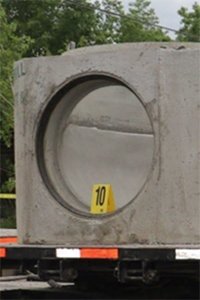
At the site of a street reconstruction project, two workers were unloading concrete sewer components from a flatdeck trailer. One worker was operating an excavator and the other worker was rigging the components to be lifted off the trailer using the excavator. During a lift, the load shifted and part of it fell, fatally injuring the second worker.
Investigation conclusions
Causes
- Lid fell, striking and trapping worker. Two heavy concrete components, a barrel and a lid, were rigged to be lifted off the flatdeck at the same time. As the lift began, the load shifted. While the worker who had rigged the load attended to the problem, the load shifted further, causing the lid to come off the top of the barrel. The worker and the lid fell to the ground. The worker was struck and trapped by the fallen concrete lid.
- Lid was lifted in unbalanced manner. The rigged load was unbalanced because its centre of gravity was too high in relation to the lifting chains applied to it. If the lid and the barrel had been lifted individually, the incident would likely not have occurred.
Contributing factors
- Failure to identify hazards and assess risks. A morning safety meeting was held at the excavation company’s headquarters on the day of the incident, but because the company’s workers were not aware that the load of concrete components would be delivered that day, hazards associated with removing the load from the trailers were not discussed at the meeting. When the load arrived at the site, the worker and the excavator operator had an informal discussion of some hazards related to unloading the components from the trailer, such as nearby power lines and pedestrian traffic at the site. Unbalanced loads were not discussed. A proper hazard identification and risk assessment for the task of unloading the components was not performed before the workers carried out the task.
- Lack of safe work procedures. Neither the excavation company nor the paving company (the prime contractor) provided the workers with safe work procedures to mitigate the risks associated with handling the heavy sewer components. As a result, workers created their own procedures, based on their own knowledge and experience, to unload the concrete components. When the load shifted, upsetting their normal practice, the workers improvised to address the problem, which exposed them to unsafe working conditions.
- Lack of training. The employer (the excavation company) did not ensure that the workers were trained to rig loads for the type of lift they were carrying out, or to recognize hazardous conditions that may develop during rigging and lifting operations and to address them safely. As a result, two components were rigged for the lift, and the centre of gravity for the load was not considered, nor was how an off-balance lid on a barrel would dramatically shift and tilt when rigged using only two lifting points. After the load shifted the first time, the operator set the swinging load back onto the base component while the worker was in close proximity to the hazard. The worker was holding the lift, trying to guide it back on top of the base component, while standing on the top edge of the base component.
- Inadequate supervision. The prime contractor did not effectively oversee the work performed by the excavation company in terms of health and safety compliance. Most of the prime contractor’s interactions with the excavation company’s workers focused on operations, and the subject of rigging and lifting the concrete components was never addressed. Neither the excavation company nor the prime contractor provided information or instruction on the requirements for safe lifting procedures, such as lifting one component at a time, or the steps that should be followed if a load shifted, so that workers were not exposed to the hazards from shifting or unexpected release of the heavy concrete components.
- Inadequate oversight by prime contractor. The prime contractor had the excavation company (subcontractor) sign a safety compliance agreement, but then failed to monitor and assess the subcontractor’s actions against its requirements. The prime contractor’s failure to review its subcontractor’s safety system caused the prime contractor to overlook key omissions on the subcontractor’s part. The subcontractor did not meet the prime contractor’s requirements in terms of providing services safely. The prime contractor never put a process in place to ensure that rigging and lifting of concrete components was performed safely and in compliance with each employer’s expectations in terms of planning, training, and supervision.
Other safety issue
- Failure to inspect equipment. Neither routine monthly inspections nor daily pre‑work inspections were performed on the chains and clutches used for the lift. Although the condition of this lifting equipment was not found to have contributed to the incident, regular inspections of lifting equipment are required by the Occupational Health and Safety Regulation.
2021-04-22 20:42:33