
Welding shack pulled downslope by pipelayer, injuring two workers
Date of incident: July 2022
Notice of incident number: 2022182060066
Employer: Pipeline construction company
Incident summary
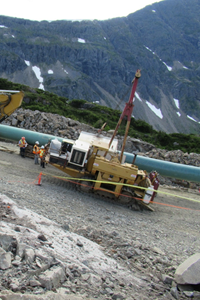
A worker was at the controls of a side-boom pipelayer (heavy equipment used to lift and move pipes) that was connected to a welding shack that had been placed over the top of a joint in a natural gas pipeline. Four workers were welding the joint inside the welding shack. The pipelayer was on a short slope, and after about 20 minutes it unexpectedly rolled downslope. The pipelayer’s movement pulled the welding shack downslope with it. Two workers inside the welding shack sustained injuries.
Investigation conclusions
Cause
- Parking brake did not hold when foot brakes were released. After the pipelayer’s engine was shut off and the parking brake was engaged, the pipelayer was likely repositioned and the parking brake re-engaged. Because of the older-model pipelayer’s braking system, the parking brake did not hold when the foot brakes were released while parked on a slope. When the foot brakes were released, the pipelayer rolled downslope and pulled the welding shack it was connected to forward.
Contributing factors
- Machine selection. The work being completed at the time of the incident involved the operator using the pipelayer to set down the welding shack and then remain connected to it on a slope. The pipelayer had an inherent limitation in the braking system — if the parking brake was engaged after the engine was turned off and then adjusted in any way, the parking brake would not hold when the foot brakes were released. In addition, the pipelayer did not have a secondary braking system, which would engage automatically when there is a loss of power or hydraulic pressure. It was therefore not the ideal pipelayer to select and use for this type of work on slopes. Newer pipelayers equipped with secondary braking systems were available.
- Operator and machine interface. The limitation in the braking system of the pipelayer used in the incident was not known by the operator or specifically identified in the employer’s operating procedures. The controls in place to prevent the pipelayer from moving forward on a slope were administrative, relying heavily on the operator and the supervisor to know and remember the limitations of each specific machine.
- Economic and organizational pressures. Due in part to the effects of the COVID‑19 pandemic, the employer was having difficulty finding and retaining qualified machine operators. As a result, operators were being moved around to operate different machines with varying control configurations, boom lengths, dimensions, braking systems, and overall capacities. Workers were also switching between different work processes and working with different crews. This increased the risk of human error.
- Adaptations not accounted for. The possibility of operators needing to leave the pipelayer for any reason was not accounted for by the employer’s safety management system. Operators were expected to stay alert at the controls for hours. Although that was the rule, it was not consistently enforced, and it did not reflect what was actually happening. The work being done involved adaptations, including the operators occasionally leaving the controls. The work should be designed to account for a margin of human error and to fail safely whenever possible.
2021-04-22 20:42:33