
Ladder retracted unexpectedly, causing worker to fall to pavement
Date of incident: July 2023
Notice of incident number: 2023178000013
Employer: School district
Incident summary
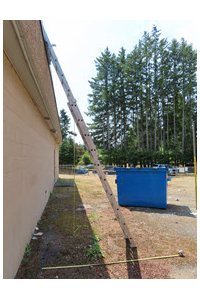
A worker was on the flat roof of a one-storey school building checking its HVAC equipment. (HVAC stands for heating, ventilation, and air conditioning.) When the worker stepped back onto the extension ladder he had used to get onto the roof, the ladder retracted and he fell about 3.8 m to the ground, sustaining serious injuries.
Investigation conclusions
Cause
- Ladder retracted unexpectedly. While the worker was on the roof, video surveillance footage shows that the ladder’s feet moved about 30 cm out from where the worker had positioned them before climbing up. As a result, the ladder’s rung locks became disengaged. The footage does not show anything jostling the ladder at ground level during this time, so the most plausible explanation for the ladder’s movement is that the worker somehow came in contact with the top of it while he was on the roof, possibly without realizing it. When the worker stepped onto the ladder to descend from the roof, the ladder’s fly section slid down, and the worker fell to the pavement below.
Contributing factors
- Use of unsecured ladder. The worker set the ladder up within the brackets of a ladder clamp, a securement tool affixed to the roofline of the building. The employer had also provided a D-ring as a method for workers to prevent the base of the ladder from moving. However, the D-ring was not located in a position where it could be used in conjunction with the ladder clamp. Even if he intended to do so, the worker was not able to secure the bottom of the extension ladder using the D-ring. The movement of the bottom of the ladder away from the building caused the rung locks of the ladder to disengage and to rest on the rung. Had the bottom of the ladder been secured from movement, the series of events that followed could not have occurred.
- Failure to remedy unsafe condition. Corrective measures in response to a similar incident in March 2023 at another worksite were applied only to the site where that incident occurred, not to other worksites. D-rings were not located beneath ladder clamps at all worksites, and the HVAC team members, including the lead hand, were not informed of the requirement to secure the bottom of the ladder to the D‑ring as part of regular extension ladder use. As a result, the worker was not aware of the hazardous condition that was present in the course of his work.
data-bs-keyboard="true">
2021-04-22 20:42:33