
Explosion and fire in confined space seriously injured worker
Date of incident: September 2022
Notice of incident number: 2022173520001
Employers: Roofing company; construction management company (prime contractor)
Incident summary
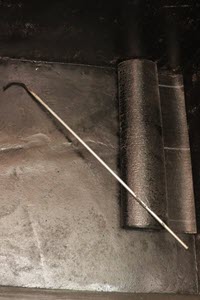
A worker was waterproofing a confined space (a tank) inside a water feature mechanical room at a large commercial and residential condominium development. The worker applied primer and allowed it to dry, and then used a hook to apply a piece of waterproof membrane to the inside of the tank. While standing on a pipe on the outside of the tank, the worker leaned into the tank and ignited a torch, which caused an explosion and fire. The worker sustained serious injuries.
Investigation conclusions
Cause
- Use of open-flame torch with flammable primer. The worker had applied the primer, whose vapours were highly flammable, and then had been tasked with using an open-flame torch-on method to seal the waterproof membrane. When the worker ignited the open-flame torch, the flammable vapours from the primer exploded.
- Accumulation of flammable vapours. Not only was the open-flame torch-on method being used in the same area as the highly flammable primer, but the work was also being conducted in a confined space without adequate ventilation. The setting for the work greatly increased the risk that the vapours would ignite.
Contributing factors
- Lack of hazard identification and risk assessment.
- Although the worker’s employer was aware of the hazard of using the torch-on method after applying the flammable primer, the worker was not alerted to this hazard and a specific confined space hazard assessment for the work was not completed.
- The prime contractor had identified the water feature tank as a confined space and had posted a sign on the door of the mechanical room the tank was located within. However, it was not clear that the tank was the confined space that was being identified. No evidence was found that a formal confined space entry hazard assessment had been done by a qualified person or that the required confined space entry program had been fully implemented.
- Lack of safe work procedures. Neither the employer nor the prime contractor had put in place safe work procedures to ensure that the worker was protected while working with a hazardous material in a confined space.
- Inadequate training, instruction, and supervision. The employer did not adequately train either the worker or his supervisor in working with a hazardous substance and working in a confined space. The employer also did not provide the worker with direct supervision at the worksite. On the day of the incident, the employer did not provide adequate training, instruction, or supervision specific to the work being done with the hazardous material in the confined space.
- Prime contractor did not fulfill responsibilities. The prime contractor did not adequately ensure that the activities carried out by the employer relating to occupational health and safety were coordinated or ensure that the employer adhered to the Workers Compensation Act and the Occupational Health and Safety Regulation. The signage identifying the mechanical room as a confined space should have prompted the prime contractor to establish and maintain a system or process with the employer that would have resulted in the tank-waterproofing work being conducted safely with all confined space provisions being fully implemented. The prime contractor should not have authorized the employer to start work in the tank until it had confirmed that the employer had established all of the required confined space entry protocols. Further, the prime contractor did not ensure that the confined space was properly identified as a hazard or that safe work procedures were established for all workers at the worksite.
2021-04-22 20:42:33