
Concrete pump truck’s boom collapsed due to unidentified fractures in link
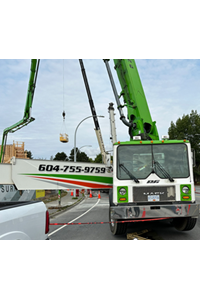
Date of incident: August 2023
Notice of incident number: 2023161950005
Employers: Concrete pumping firm; pump truck supplier; engineering firm
Incident summary
At a multi-residential construction site, a crew of nine workers was placing concrete in wall formwork. The concrete pump truck’s five-segment boom was partially extended. The boom suddenly broke between its third and fourth sections, and the fourth and fifth sections, along with the boom’s rubber discharge hose, fell to the ground. The workers scattered as the boom collapsed. No injuries were reported.
Investigation conclusions
Cause
- Fractures in boom link. Fatigue cracks in boom link 5 caused the fourth and fifth sections of the concrete pump’s boom, as well as its hose, to fall to grade level during the placement of the last load of concrete. The fatigue cracks, a result of wear from transporting the boom on its truck bed and using it to pump concrete, had likely been growing over several years and had not been identified during inspections. The cracks were related to a design issue, not to the materials used to fabricate the link.
Contributing factors
- Manufacturer did not notify client of upgraded link. In 2007, the concrete pump’s supplier was notified by the manufacturer overseas of two separate upgrades to the design of boom link 5. The first upgrade, in late June, was applied to the pump truck involved in the incident, known as unit 11. The second, in early July, was not. The supplier did not notify the concrete pumping firm that owned unit 11 at that time of this second upgrade, nor did it advise the employer of it when the employer purchased unit 11 from that owner or at any subsequent time. As a result, unit 11’s boom was being used for years with a part that did not match current specifications and that was prone to developing cracks.
-
Lack of guidance on inspection technique and design issue led to failure to identify fatigue cracks.
- The investigation found that poor inspection practices failed to discover the growing fatigue cracks on the link. However, standards and regulations do not specifically identify the need to disassemble the boom during an annual inspection, and guidance on this should have been provided to the employer by the supplier.
- Neither the engineering firm hired to inspect the concrete pump nor the employer was provided with information from the supplier about boom link 5 needing an upgrade. If this issue had been communicated to either firm, it is possible an adequate inspection plan for the concrete pump would have been created.
Other health and safety issues
-
Failure to ensure unit was adequately inspected post-misadventure.
- In March of 2023, unit 11 was involved in a misadventure in which the boom’s fifth section and hose contacted the ground after the unit partially sank into excavated ground. This mishap automatically classified unit 11 as not safe to use.
- Afterwards, unit 11 underwent an initial inspection by the engineer, who was not given details about the misadventure. Certain repairs were then performed on unit 11. Additional repairs were still necessary. Before that work could take place, the engineer needed to receive the results of a mechanical inspection on unit 11 by the employer, to enable him to draw up an inspection plan. Once the mechanical inspection was received and the remaining repairs were done, the engineer would provide a final report on all the inspections carried out on unit 11. The engineer never received the mechanical inspection results from the employer, though, so he was not able to devise the plan or produce the final report.
- The employer was advised by the engineering firm on June 23, 2023, that the inspection process was not yet complete, and therefore should have been aware that unit 11 was not safe to use.
-
Misinterpretation of decal.
- Decals reading “Engineering Certification Reference” at the top are routinely affixed to concrete pumps prior to final sign-off from an engineer. This type of decal was affixed to unit 11 in the course of the engineering firm’s previous annual inspections in 2021 and 2022, as well as after the misadventure in March 2023. The decal is a document reference and is not intended to indicate that a full inspection has been completed. Therefore, the mere fact of such a decal appearing on a concrete pump does not indicate whether the equipment has been certified as safe for use.
- Given the employer’s knowledge of and previous experience with the process for post-misadventure inspections, it is unclear why the employer’s staff members believed the decal affixed to unit 11 with an “inspected on” date of March 14 signified the completion of the inspection process. Repairs were not completed by that date, nor were they ever reviewed by an engineer. The employer also did not receive a final inspection report from the engineering firm with an engineer’s stamp.
- Logbook entries insufficient for monitoring inspection intervals. The employer’s logbook entries did not include all inspections, the names of those who did repairs, total hours of service recorded, or details of misadventures. In particular, the employer had not logged hours of use correctly and may not have been obtaining inspections at the intervals required under the Occupational Health and Safety Regulation.
data-bs-keyboard="true">
2021-04-22 20:42:33