
British Columbia has one of the busiest tower-crane sectors in North America. WorkSafeBC is making crane work safer — through stronger certification, more inspections, modern regulations, and close industry partnership. Here you’ll find how the strategy works, the progress we’re making, the resources you need, and answers to common questions.
This page brings together our strategy and progress, connects stakeholders to resources and partners, and addresses the questions and misconceptions we hear most often. We update it quarterly.
Strategy at a glance
373
Active tower cranes in B.C.
1300
Inspections in 2025
(373 in Q1 2026)
50%
Drop in provisional tower crane operators
(2024—2026)
Crane licensing and permitting program announced by the B.C. Government on March 3
Better crane safety protections coming for workers. Learn more.
New tower crane requirements in effect October 1, 2024.
Employers must submit a Notice of Project (NOP) before any tower crane erection, climbing, repositioning, or dismantling, and ensure a qualified supervisor is in place. Learn more.
Explore the strategy
The strategy is built around four core areas of activity.
The Provincial Crane Inspection Team (PCIT) is WorkSafeBC's specialized crane and rigging inspection team within Prevention Field Services. The team has nearly tripled in size over the past two years and now operates with a risk-based focus on the worksites where the safety stakes are highest.
- 16 officers with specialized crane and rigging expertise — nearly tripled in two years
- 1,300 inspections completed in 2025 across B.C. (Q1 2026 completed 397)
- 1,400 orders issued, including
- 110 stop-use orders (Q1 2026 issued 45)
- 51 stop-work orders (Q1 2026 issued 5)
- Focus on complex and multi-employer worksites
Our programs cover certification, training, regulation, and safety guidance.
Operator certification
- Crane operator certification in B.C. is administered by the BC Association for Crane Safety (BCACS) under section 14.34.1 of the Occupational Health and Safety Regulation (OHSR).
- On August 1, 2025, the number of questions on the provisional operator exam was increased and included Tower Crane Load Chart and Rigging exam questions being reinstated.
- BCACS is pursuing ISO standard 17024 Conformity assessment — General requirements for bodies operating certification of persons alignment for its certification framework.
Training and workforce skills
WorkSafeBC supports BCACS, Fulford Certification, and SkilledTradesBC on operator training pathways, supervision standards, and on-the-job competency development. Since the strategy was launched, the share of provisional operators has dropped approximately 50%, which means an improved ratio of trainee operators to fully certified operators.
Regulatory enhancements
The Notice of Project (NOP-TC) — Tower Crane regulation came into force October 1, 2024. It requires employers to give WorkSafeBC two weeks’ notice before erection, climbing, repositioning, or dismantling, and to confirm a qualified supervisor and a site-specific safe-work procedure.
A one-year compliance review in November 2025 reported more than 900 NOP-TC submissions received and good overall compliance.
Safe-for-Use Certification (in development)
A framework expected in 2027 will require major tower crane components (structural, mechanical, controls) to be certified by a professional engineer before operation, with annual recertification.
Rigging Part 15 (in development)
Regulations are being updated to ensure rigging equipment, procedures, and maintenance meet current industry standards, and to clarify the safety-critical competencies expected of workers and employers.
Regulation and Standards
- OHSR Part 14: Cranes and hoists, including NOP–Tower Crane requirements (October 1, 2024). In force.
- CSA Z248-2004: Code for Tower Cranes — primary B.C. reference standard. Current OSHR reference.
- ISO 17024: International standard for bodies that certify persons. BCACS pursuing accreditation. In development.
Tower crane safety in B.C. is a shared responsibility. The strategy is the product of a network of partners. Each brings a distinct role.
- WorkSafeBC
Provincial regulator. Leads the strategy and operates the PCIT. - Crane Safety Table
Convened by the Minister of Labour (June 2025); shaped the March 2026 licensing announcement. - BC Crane Safety (BCACS)
Administers operator certification under OHSR 14.34.1; pursuing ISO 17024 alignment. - Fulford Certification
BCACS's independent testing partner. Administers exams and practical assessments. - Engineers and Geoscientists BC
Practice guidelines for engineer-of-record responsibilities on crane work. - Minister of Labour
Convened the Crane Safety Table; announced the crane licensing program (March 3, 2026). - BC Building Trades
Worker voice on the Crane Safety Table; direct operator and crew perspectives. - IUOE Local 115
International Union of Operating Engineers; represent crane operators.
Progress timeline
Key milestones in the strategy since launch:
| March 2024 | Stakeholder Summit 130 stakeholders convened to shape the strategy. |
| October 1, 2024 | NOP-Tower Crane regulation in force Two weeks’ notice required before erection, climbing, repositioning, or dismantling. |
| February 2025 | Crane rigging safety bulletin Focused on reducing the risk of rigging failures. |
| June 2025 | Crane Safety Table established Convened by the Minister of Labour — regulators, industry, labour, technical experts. |
| July 2025 | Flytables safe-work practices video New resource on moving flytables safely on construction sites. |
| August 1, 2025 | Provisional operator exam reform Fulford Certification expanded the exam from 23 to 40 questions; Tower Crane Load Chart and Rigging exam reinstated. |
| November 2025 | One-year NOP compliance review 900 submissions, good compliance, 50% reduction in provisional operators. |
| December 2025 | $1.3M in crane-related penalties published Penalties database updated with crane-related safety violations. |
| March 3, 2026 | Crane licensing and permitting program announced Minister of Labour announces program based on Crane Safety Table recommendations. |
| July 6, 2026 | Skilled trades certification expands to tower and mobile crane operators Minister of Post-Secondary Education and Future Skills announces adding trades training certification for B.C. crane operators. |
| Expected 2027 | Safe-for-Use Certification framework Engineer-certified components and annual recertification. |
Resources
Tools, guidance, and publications related to tower crane safety. For the full library of crane resources, see Forms & Resources.
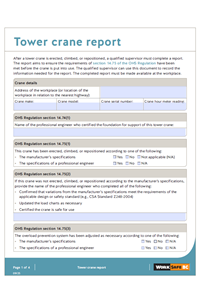
Tower crane report
Under the Occupational Health and Safety Regulation, a qualified supervisor must complete a report after a tower crane is erected, climbed, or repositioned on a worksite. Supervisors can use this resource...
Title
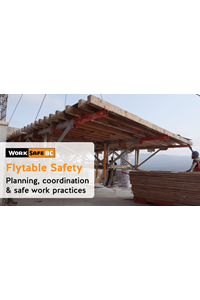
Flytable Safety
Moving flytables (also known as flyforms) from one level to another during the construction of highrise buildings is a critical task that carries a lot of risk. This video shows how careful planning,...
Title
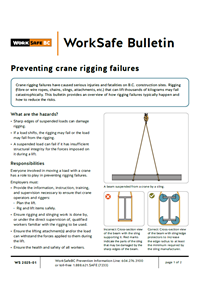
Preventing crane rigging failures
Crane rigging failures have caused serious injuries and fatalities on B.C. construction sites. Rigging that can lift thousands of kilograms may fail catastrophically. This bulletin provides an overview...
Title
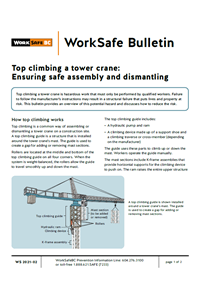
Top climbing a tower crane: Ensuring safe assembly and dismantling
Top climbing, a common way of assembling and dismantling a tower crane, is hazardous work that must only be performed by qualified workers.
The importance of tower crane safety was brought to...
Title
- Crane operator certification
How certification works in B.C.: the roles of the BC Association for Crane Safety and Fulford, and the provisional-to-full-scope pathway. - Submit a Notice of Project form
Submit at least two weeks before any tower crane erection, climbing, repositioning, or dismantling.
Frequently asked questions
Answers to the questions we hear most often — about operator qualifications, supervision, and how the strategy is structured.
Operator qualifications and certification
No. Certification is administered by the BC Association for Crane Safety (BCACS) under OHSR 14.34.1. Testing is conducted by Fulford Certification, an independent testing partner, on BCACS’s behalf and issues your card. This separation protects impartiality.
Provisional (Level B) certification lets you operate under qualified supervision while you build hours and complete exams. Full Scope (Level A) is the highest level and requires a successful practical assessment plus the relevant theory exams. They are employer-tied with specific conditions, including time limits and require supervised operation.
It depends on where your certification is from. BCACS generally recognizes credentials from other Canadian jurisdictions and from National Center for Construction Education and Research (NCCER), National Commission for the Certification of Crane Operators (NCCCO), Ontario Expert Commission on Pensions (OECP) (USA), An tSeirbhís Oideachais Leanúnaigh agus Scileanna (SOLAS) (Ireland), the U.K., and parts of Europe. Contact BCACS directly to confirm.
Crane operations and supervision
Employers must submit an NOP-TC to WorkSafeBC at least two weeks before erection, climbing, repositioning, or dismantling a tower crane. The NOP confirms that a qualified supervisor and a site-specific safe-work procedure are in place.
Supervision is a defined role with specific competency requirements. Part 14 of the OHSR requires a qualified supervisor for tower crane erection, climbing, repositioning, and dismantling, and that they complete a report afterward. Qualifications are confirmed through the NOP submission.
The NOP-TC requirement covers erection, climbing, repositioning, and dismantling. Routine day-to-day crane operation does not trigger a separate NOP-TC, but day-to-day operation is governed by the rest of OHSR Part 14.
Responsibility is shared between the prime contractor and the employer of the tower crane crew. The prime contractor has overall responsibility for coordinating safety on a multi-employer site. Each employer remains responsible for their own workers. For tower crane work specifically, the employer of the crew performing the erection/climbing/dismantling must submit the NOP-TC and ensure the qualified supervisor is in place.
Strategy, oversight and partners
WorkSafeBC’s specialized crane and rigging inspection team within Prevention Field Services. The team has 16 officers.
No. The Crane Safety Table was established by the Minister of Labour in June 2025 and is convened by and reports to the provincial government. WorkSafeBC participates in the table as part of our ongoing work to improve crane safety, building on crane and mobile equipment initiatives that have been underway for many years.
The provincial crane licensing and permitting program (rolling out through Ministry of Labour and WorkSafeBC), and a Safe-for-Use Certification framework expected in 2027 requiring engineer-certified components and annual certification.
Contact
If you have a question, a suggestion, or feedback on how this page can better serve you, please contact us or call the Prevention Information Line at 1.888.621.7233.
See also
- Submit a Notice of Project
- Crane operator certification
- Cranes and mobile equipment
- Construction industry
- Occupational Health and Safety Regulation, Part 14
Web resources
- BC Association for Crane Safety (BCACS)
- Fulford Certification
- Tower Crane Site Binder
- Engineers and Geoscientists
- SkilledTradesBC
Highlights
- Crane licensing and permitting announced March 3, 2026
- $1.3M in crane-related penalties December 12, 2025
- Flytables safe-work video July 31, 2025
- Rigging failures bulletin February 19, 2025
- New tower crane requirements October 1, 2024
Planning crane work? Submit a Notice of Project using the online form.