
Hidden hazard in construction: Road safety risks beyond jobsites
Published on: March 24, 2025
As construction season kicks off this spring, employers in B.C.’s construction industry can’t overlook the risks their workers face daily when driving for work.
By Marnie Douglas
The general construction sector saw the fourth-highest number of motor vehicle incident-related claims over the last 10 years, with 1,122. Construction trades helpers and labourers accounted for 361 of those claims. With an average of one motor vehicle incident every 2.3 workdays, addressing road safety is critical to protecting workers, reducing costs, and ensuring compliance with the Occupational Health and Safety Regulation.
Keeping workers safe on the road requires employers to address the unique driving risks in the construction industry. This includes:
- Preparing staff to handle the demands of frequent travel between jobsites
- Ensuring vehicles are properly maintained
- Providing drivers with the training and resources needed to manage challenges such as fatigue, time pressure, and distractions on the road
“Every construction sector employer whose workers drive as part of their job needs to address driving safety in their health and safety program,” says Quinto Vizza, industry and program specialist at WorkSafeBC. “Employers must ensure workers are aware of the risks, trained to handle challenges like fatigue and distractions, and prepared to plan ahead for safe travel between jobsites.”
Every vehicle is a worksite
Road Safety at Work spokesperson Trace Acres says that any driving a worker does in the course of their workday, whether on the jobsite or not, is considered work-related. And it doesn’t matter whether they use a company vehicle or a personal one.
“Any vehicle used for work in B.C. is a workplace,” he says. “This means, as an employer, you are legally responsible for ensuring the safety of your employees whenever they are driving for work and your employees who are passengers in vehicles being used for work.”
Acres explains the various types of driving directly tied to the demands of a construction site:
- Travel between jobsites — Labourers and tradespeople can drive between multiple sites daily, often under tight schedules or after long, physically demanding shifts. Contractors may also be sharing vehicles.
- Delivery of materials, tools, and equipment — Construction workers use trucks or vans, including personal vehicles, to transport essential items. Whether it’s scheduled deliveries or last-minute runs, these trips can lead to rushing, distractions, and increased risks on the road.
- Client and site visits — Supervisors, project managers, and office staff also drive to inspect a building’s progress, meet with clients, or oversee projects. These trips can expose workers to the same road hazards, which are often overlooked in safety planning.
In addition, large, heavy, and specialized construction vehicles can be challenging to manoeuvre, says Erin Linde, director, health and safety services with the BC Construction Safety Alliance. Specialized machinery may be needed for hauling heavy machinery or oversized loads to and from construction sites, she explains.
Each type of driving presents its own unique set of risks.
“Fatigue from long shifts, tight deadlines leading to distractions, and neglected vehicle maintenance are just several of the significant driving risks in the construction industry,” Linde says. “Addressing these risks is crucial to keeping workers safe on the road.”
Linde suggests that employers can take several steps to reduce risk and improve driving safety, including:
- Implementing formal driving policies
- Educating workers about hazards like distraction and fatigue
- Providing sector-specific training, especially for new and young drivers
Regularly inspecting vehicles, providing driver orientation, and reviewing licences and driving abstracts are also critical. Additionally, scheduling jobs to reduce rushing and highlighting the risks faced by all workers (including office staff who visit jobsites) can help create a safer driving environment.
Prioritize road safety
Sean Abbott is the health, safety, and environment manager with PPM Civil Constructors (PPMCC), a heavy civil and marine construction company.
PPMCC builds and repairs infrastructure such as bridges, ports, piers, and docks, and several of its projects are located in northern, remote areas of the province.
“Our employees do a lot of driving,” Abbott says. “Two of the biggest risks we deal with are driving conditions and driving long distances.” Added to this, many new Canadians employed by the firm are not familiar with B.C.’s adverse driving conditions or mountainous terrain, and that can increase the driving risk.
“The driving culture can vary also. As an example, in some countries, using a horn is common practice,” Abbott explains. “But here, excessive honking is considered rude. Drivers rely more on hand and vehicle signals to communicate with other drivers.”
PPMCC completes a full driver orientation as part of their onboarding practices for new hires. They cover the inspection and operation of vehicles and equipment, and determine what previous experience employees have. Driver abstracts are reviewed annually. They don’t allow drivers to wear hoodies or headphones to help ensure clear shoulder checks and freedom from audio distraction. Each of the company’s 12 fleet vehicles include accident preparedness kits, and vehicle inspections are completed and logged monthly.
Abbott is leveraging resources from Road Safety at Work to add a driving safety section to PPM’s health and safety manual.
“We don’t have a huge fleet, but that shouldn’t matter,” Abbott says. “It’s important to make sure our employees are safe on the roads and prepared for whatever they may encounter.” Lindsay Langill, PPMCC’s Director of People and Strategy states that “it’s part of PPMCC’s initiative toward building a safety culture among all those we employ. Whether employees are driving a company vehicle or their own personal vehicle, we hope they will practice safety behaviours any time they drive.”
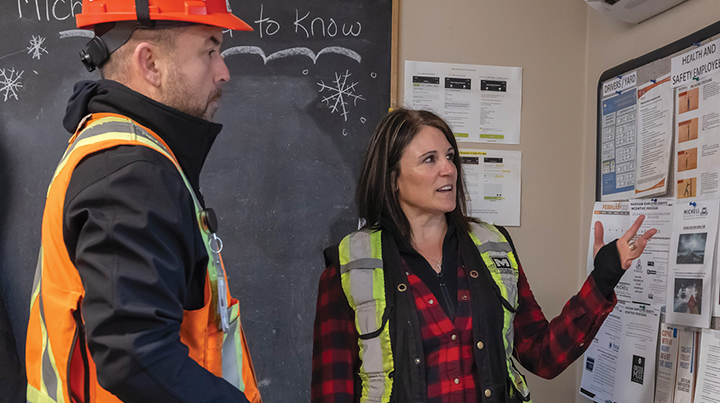
Donna Michell is the co-owner and general manager at Michell Excavating, a fourth-generation family business on southern Vancouver Island.
The company does excavation work for commercial, civil, and residential projects. Michell employs about 65 people and has several hundred pieces of equipment, from gravel trucks and excavators to a fleet of pickup trucks.
“We have folks who drive to our office every day, park their vehicle, and then drive a fleet vehicle, and we have others who drive directly to the jobsite,” Michell explains. “I personally put on more than 1,000 kilometres every month driving to and from jobsites. We do a lot of driving, and road safety is really important.”
The company has a joint health and safety committee with representation from the excavation, trucking, and management sides of the business.
Michell says the company does a full orientation with new hires so they understand policies and expectations, including a zero-tolerance drug and alcohol policy. They check driver abstracts of new hires and employees annually, and have a strict hands-free policy with zero tolerance for phone use while driving. Every truck is outfitted with winter safety gear, and carpooling to jobsites is encouraged. The safety manager visits every jobsite each week and holds toolbox talks about safe driving.
The company’s safety culture is something Michell is particularly proud of.
“The really great part about our company is that because we have employees who have been here many years, some their whole careers, we’re a very tight-knit team,” she says. “If something were to happen on a job, it’s going to affect everyone, and we take safety very seriously.”
For more information
To find more information, including training courses, tools, and resources applicable to the construction industry, visit roadsafetyatwork.ca and bccsa.ca.
Road Safety at Work is dedicated to enhancing occupational road safety across B.C. Their primary objective is to prevent work-related motor vehicle incidents by providing employers and workers with comprehensive resources, training, and guidance. They serve a wide range of industries where workers drive for work, including transportation, health care, local government, and forestry.
The British Columbia Construction Safety Alliance (BCCSA) is a not-for-profit organization dedicated to promoting health and safety within B.C.’s construction industry. Serving more than 57,000 construction companies and about 220,000 workers, BCCSA offers a range of training and resources aimed at injury prevention and fostering a culture of safety on construction sites. BCCSA serves various sectors, including residential; road building; aggregate; ready-mixed concrete; industrial, commercial, and institutional; and heavy construction.
This information originally appeared in the Spring 2025 issue of WorkSafe Magazine. To read more or to subscribe, visit WorkSafe Magazine.
Please help us understand how WorkSafe Magazine can serve you best by completing our online survey.
More in this issue
- Ask an officer: Properly fitting PPE leads to better worker protection
- A decade of data sharing distinguished by nine new dashboards
- Emergency planning for hazardous substances
- Finding strength in inspiring others
- Introducing our new OHS advisor role
- Surplus helps keep premium rates stable
- Tea manufacturing steeped in safety
- Tips to keep construction workers safe while driving