
Workers on bridge deck thrown to ground when deck moved suddenly
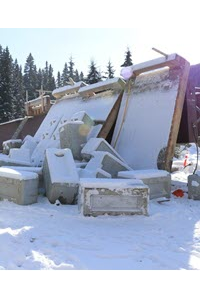
Date of incident: February 2023
Notice of incident number: 2023166950012
Employer: Bridge construction contractor
Incident summary
Workers at a pipeline construction site
were preparing to remove a temporary bridge over a frozen river. Two workers
were on the bridge deck at its west end. They were helping a crane operator
place concrete locking blocks on the deck as counterweights to create a
cantilever system. The locking blocks weighed about 1902 kg
(4200 lb.) each. Thirty-six of them were already on the bridge deck, and
two more were being positioned on it when a sudden release of energy occurred.
The end the workers were on moved downward suddenly and then immediately
returned to near its previous position. The movement threw the bridge
deck’s wooden panels, along with the workers and the locking blocks, to
the ground beside the bridge. The two workers sustained serious injuries.
Investigation conclusions
Cause
-
Unplanned release of energy caused bridge to fail.
- A large piece of timber at the opposite (east) end of the bridge was being used as a resting point for the bridge’s girders. This timber was called a “sill plate,” and was firmly embedded in the frozen riverbank.
- Also at the east end of the bridge, an apparatus called a “launch nose” had been attached to the girders to help remove the bridge. The launch nose had been reinforced with devices called “side guides” on its sides. The side guides were chained and bolted to the sill plate. This was done to enable the crew to pull the sill plate out of the frozen ground in tandem with removing the bridge.
- As the locking blocks were added to the west end of the bridge, strain energy accumulated in the girders and in the launch nose assembly because the launch nose was attached to the sill plate. Finally, the upward force being created in the attachment overcame the resistance of the sill plate. The sill plate snapped, the bolts were ripped from the sill plate, and the stored energy was released. The upward force travelled along the bridge from east to west, ejecting the two workers and the locking blocks from the bridge surface.
Contributing factors
- Work performed outside scope of engineering plan. The engineering plan did not include attaching the launch nose to the sill plate. This step was done to save time and was not designed or approved by a professional engineer. It was outside the scope of the engineering plan, and it resulted in the failure of the bridge structure.
- Inadequate hazard identification and risk assessment. Deviating from the engineering plan, without having the change certified by an engineer, meant that the hazard controls outlined in the existing engineering plan were no longer adequate. The hazard of uncontrolled movement of the massive bridge components was not identified, and the related risks were not eliminated or lessened.
-
Inadequate supervision.
- The employer devised a work plan that was outside the scope of the engineering plan — namely, attaching the launch nose to the sill plate so that the sill plate could be removed along with the bridge deck and girders instead of separately. The crew was directed to carry out this change in work process without getting the new method certified by an engineer. Had proper supervision been provided for the task of removing the bridge, work would not have been performed outside the scope of the engineering plan.
- In addition, when the bridge had been installed the previous year, supervisors permitted the sill plate to be lodged in the riverbank in a manner contrary to the engineering plan.
- Inadequate safe work procedures. The employer did not have a safe work procedure (SWP) for the bridge removal process. Workers were following in reverse order the SWP for installation, which might have been adequate to protect the workers if the bridge installation and removal had adhered to the engineering plan devised for those two stages of the project. However, the installation of the bridge had not followed the engineering plan, and the work process for removal was altered in the field. These anomalies rendered the SWP for installation inadequate for the removal.
- Inadequate fall protection methods. Fall protection for one of the two workers, who was standing on one of the bridge deck panels, consisted of the bridge deck’s guardrail. The other worker, standing on the locking blocks piled on the bridge deck, was using a fall restraint system anchored to the wire lifting point on one of the locking blocks — not a suitable anchor. These methods of fall protection were both crucially compromised by the failure of the bridge components when the stored energy in the girders and in the launch nose assembly was released.