
Worker seriously injured when struck by falling I-beam structure
Date of incident: May 2024
Notice of incident number: 2024157440006
Employers: Construction supervisor/consultant; general contracting company
Incident summary
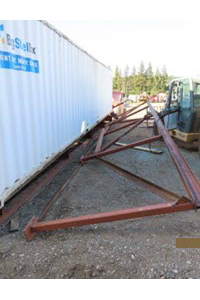
In an equipment yard, three workers were using mobile equipment to construct a storage shop made of two parallel metal shipping containers with a roof over the space between them. A steel I-beam structure was on top of each shipping container to act as a roof-support wall. When a skid needed to be placed under one of the shipping containers, two workers elevated the shipping container using a telehandler at one end and an excavator at the other end. A second telehandler placed the skid under the shipping container from the space between the two containers, and then the operator left the cab. At the same time, the excavator operator attempted to manoeuvre the elevated shipping container using the excavator boom. The roof-support wall on top of the shipping container fell 2.6 m (8½ ft.) and struck the telehandler operator, who sustained serious injuries.
Investigation conclusions
Cause
- Unsecured roof-support wall fell from top of shipping container. The roof-support walls had not been fastened to the shipping containers when placed on top of them. Both roof-support walls had three steel back braces welded to them to hold them upright, but they had no support to stop them from tipping over into the space between the two shipping containers.
Contributing factors
- Lack of planning and hazard assessments. The general contracting company had contracted the construction supervisor/consultant and assigned the construction of the storage shop to him. The supervisor did not know the roof-support walls were not secured when he was operating the telehandler between the shipping containers and was injured in the incident. It had been decided to build the storage shop using two empty shipping containers and trusses from a demolished building. No drawings or plans were created. The roof ought to have had erection plans and instructions from a professional engineer. Had the general contracting company’s occupational health and safety program been followed regarding job hazard assessments and daily pre-work hazard assessments, the unsecured roof-support walls would have been flagged as a hazard once they were on top of the shipping containers, and the supervisor would have been alerted.
- Inadequate communication. The fact that the roof-support walls had not been secured when placed on top of the shipping containers was not communicated to all the workers. The three workers relied on eye contact and hand signals to coordinate the activity between the two telehandlers and the excavator. They were not positioned in each other’s line of sight and had no other backup method of communication, like radios. When the supervisor left his telehandler to inquire about a delay in lowering the shipping container onto the skid that he had placed under it, he was not aware that the other workers were still manoeuvring it using the excavator. As he was positioned directly below the overhead hazard, he was struck by the roof-support wall when it fell.
- Hazardous lift. During the lift of the shipping container with a telehandler and an excavator, two workers operating different machines were attempting to coordinate without a plan and were only using hand signals to communicate. The telehandler operator exited the machine and walked over to the excavator to provide direction for orienting the shipping container so it could be placed on the skid. One end of the elevated shipping container and the telehandler holding that end up were left unattended while the excavator was manipulating the other elevated end. This unstable situation — the shipping container not being supported by anything other than the forks of the telehandler and the rigging attached to the excavator — caused the shipping container to shake and the unsecured roof-support wall to fall.