
Worker on break fell through unguarded floor opening, later died
Date of incident: August 2023
Notice of incident number: 2023194040008
Employers: Flooring company; general construction contractor; school district (prime contractor)
Incident summary
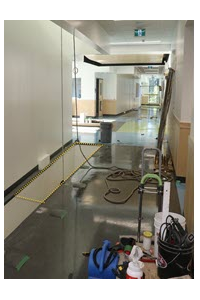
At a newly built elementary school, officials decided to remove metal railings around openings on the second floor that overlooked the first floor. The metal railings were to be replaced with glass partitions. In the meantime, holes in the flooring material created by the metal railings’ feet needed to be repaired. A flooring worker was on the second floor repairing some of these spots at the edge of one of the openings. The worker was using a fall protection harness. At lunchtime, the worker unhooked his harness from the lifeline and walked down the hallway to its opposite end, where he fell through a similar floor opening to the first floor. The worker was transported to hospital but later succumbed to his injuries.
Investigation conclusions
Cause
-
Worker without fall protection fell through unguarded opening.
- Having detached his harness from the fall protection system, the worker walked north along the hallway and fell approximately 4.2 m (13 ft. 8 in.) from the edge of the floor opening at the north end of the hallway to the surface of the hallway on the first floor.
- As with the floor opening that the worker had been working next to, metal railings around the opening at the opposite end of the hallway had been removed. The edge of the opening was unguarded and unmarked, and the opening was uncovered.
Contributing factors
- Inadequate supervision. Supervision of the worker at the site was inadequate. The general contractor devised a fall protection plan (FPP) for the floor repair work, which was followed in part by the worker. However, the flooring company did not ensure that its own supervisor on the project was aware of the FPP’s contents. The worker’s direct supervisor and the construction firm’s supervisor were not present at the worksite when the incident occurred.
- Inadequate training. The fall protection training provided to the worker was inadequate, as it did not meet the standards outlined in each of the employers’ health and safety programs. The training was also ineffective as the FPP was not being adhered to when the incident occurred.
- Inadequate safety coordination. The overall coordination of site safety pertaining to occupational health and safety was inadequate. The school district believed the construction firm was capable of coordinating site safety and believed the intent was for the construction firm to do so. However, there was no written prime contractor agreement with the construction firm for the railing replacement work. Prime contractor responsibilities were not effectively assumed nor adequately delegated by the school district.
-
Lack of adherence to each employer’s health and safety program.
- All three employers did not ensure that work at the site adhered to the guidelines set out in their individual health and safety programs.
- The school district’s health and safety program detailed extensive fall protection training and education that must be undertaken before a person is authorized to work when fall protection equipment is required. The worker did not receive the required training to be authorized under the district’s program.
- The construction firm’s health and safety program stated that the implementation of an FPP will be under the supervision of a competent person. The worker was observed working alone, without supervision, as the construction firm’s supervisor was called to a different worksite.
- The flooring firm’s health and safety program stated supervisors will ensure safe work practices are followed. The FPP specified that the worker will be tied off at all times while working at the edge of a floor opening. The investigation found that the worker was not tied off when he fell from the edge of the north floor opening on the second floor.
Other health and safety issues
- Non-compliant fall protection equipment. Some components of the fall protection system in place at the time of the incident did not meet regulatory requirements. For example, the vertical lifelines lacked manufacturer’s markings, and the personal energy absorber attached to the worker’s harness did not have markings listing its type or the standard to which it was fabricated. Given that the worker was not using the fall protection equipment when the incident occurred, these deficiencies did not contribute to the incident.