
Worker fatally injured when formwork panel fell on him
Date of incident: September 2024
Notice of incident number: 2024171900012
Employers: Construction and development company (prime contractor); formwork services company; crane rental company
Incident summary
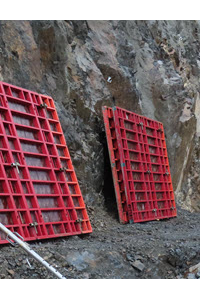
A worker at a construction site was working with a tower crane that was moving large formwork panels (moulds for concrete). Several panels were being stored vertically, leaning against a rock face. The worker climbed up one of the panels to disconnect the lifting hooks (part of the crane’s rigging) from the top of the panel. During this process, the panel fell on the worker. The worker sustained fatal injuries.
Investigation conclusions
Cause
- Rigging interacted with panel and panel fell over. The worker was climbing on the formwork panel, which was leaning vertically against a rock face, in order to disconnect the two lifting hooks from the panel. The crane operator began raising the rigging and trolleying it in (moving the rigging horizontally along the jib) while the worker was still on the panel. The rigging interacted with the panel, causing it to fall over.
Contributing factors
- Panels not effectively secured. The panels were stored vertically and were not effectively secured, which put the worker and other workers who were working nearby at risk.
- Worker climbed panels. The worker did not use a tool to disconnect the lifting hooks or a ladder to access the top of the panel and instead climbed the panels to perform this task. Although this was an accepted practice at the site, it was not in line with the manufacturer’s or the formwork services company’s procedures for disconnecting the lifting hooks.
- Crane movements took place while worker on panel. The rigging was raised and trolleyed in after the lifting hooks had been disconnected from the panel but while the worker was still climbing on it. This exposed the worker to the risk of the rigging snagging on the panel and causing it to fall over.
- No safe work procedures for vertical panel storage. None of the employers involved in the incident had written safe work procedures for vertical storage of formwork panels. Procedures were in place to secure the panels during concrete wall forming, but these securement methods were not used when the panels were stored vertically prior to wall forming.
- Inadequate communication. The prime contractor had procedures for communicating crane movements, including hand signals and a designated worker responsible for signalling crane movements to the crane operator. However, just before the incident, the rigging began to trolley in and raise based on a perceived signal from the worker, without an official radio or hand signal. It is not known if the worker was ready for the rigging to be moved when the incident occurred.
- Inadequate coordination of work. The prime contractor at this multiple-employer worksite did not identify the hazard of the ineffectively secured vertical panels and did not adequately control the risk of a panel falling over while a worker was climbing it or working nearby.
- Lack of effective supervision. Unsafe work practices, such as those that resulted in the incident, were occurring throughout the day and were not corrected. The supervision being provided at the worksite was ineffective.
2021-04-22 20:42:33