
Worker died when pressure washing wood fibre storage silo
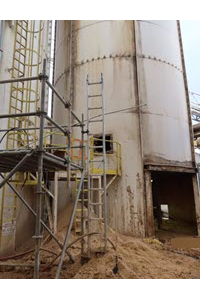
Date of incident: January 2025
Notice of incident number: 2025207290004
Employers: Industrial pressure washing company; medium-density fibreboard manufacturer
Incident summary
At a medium-density fibreboard (MDF) plant, workers were cleaning (pressure washing and vacuuming) a wood fibre storage silo. Wood fibre was clinging to the walls after it had been deluged with water and then had frozen in the cold weather. A worker was inside the silo, pressure washing the walls, when fibre suddenly released and engulfed the worker, causing fatal injuries.
Investigation conclusions
Cause
- Overhead hazard dislodged by pressure washing inside silo. Wet and frozen compacted wood fibre was adhered to the walls of the silo and overhanging directly above the area where the worker stood while pressure washing inside the silo. The pressure washing caused the fibre to slough off the walls, engulfing the worker.
Contributing factors
- Incomplete hazard assessment and control prior to entry. The MDF manufacturer issued a confined space entry permit before the worker entered the silo to pressure wash pieces of the overhanging fibre from below. However, the permit relied on a prior hazard assessment from several years earlier, which had assigned an atmospheric hazard rating of moderate/low inside the silo. The MDF manufacturer and the workers’ employer (the industrial pressure washing company) knew there was an overhead hazard that posed an obvious risk of sudden collapse and engulfment. No one conducted a detailed inspection or assessment of the risk level and took specific mitigation steps before the worker entered the confined space.
- Limited supervisory oversight. Multiple workers with supervisory roles were involved in the wood fibre removal operation, but none were actively overseeing the confined space entry. The general manager of the crew had been on site earlier in the day but left before the decision was made to proceed with the entry. Two responsible supervisors at the workplace did not address the overhanging fibre hazard above the work area at the time of entry. The worker was allowed to enter based on a brief visual check and the worker’s willingness even though his employer knew there was fibre clinging to the walls. The confined space entry permit was issued even though it was based on a pre-filled atmospheric hazard rating and did not address the risk of engulfment, which would make the requirements for entry more stringent.
- Inadequate rescue planning and preparedness. The MDF manufacturer employed a standby person who was responsible for gas testing and tracking entries in and out of the silo. Although there was an elevated work platform outside the silo’s access hatch, the standby person was positioned on the ground due to space limitations and could not maintain continuous visual contact with the worker while he was inside the silo. The worker wore a rescue harness, but it was not attached to a retrieval system, which is critical in a confined space with a risk of engulfment where immediate extrication may be necessary. The MDF manufacturer had a rescue agreement with the local fire department but had not held any recent confined space rescue drills. When the emergency occurred, the response relied on external emergency services and spontaneous actions rather than a structured, pre-planned rescue operation specific to the space and task, documented alongside the entry permit.
2021-04-22 20:42:33