
Worker died using gas-powered heater indoors
Date of incident: October 2023
Notice of incident number: 2023143950047
Employer: Real estate firm acting as developer
Incident summary
A lone worker was installing vapour barrier on the main floor of a house under construction. The temperature outdoors was well below 0°C, and inside the house a kerosene heater powered by a gas generator was in use. At some point the worker lost consciousness. Later that day, he did not show up to another location as expected. The next day, the worker was found unresponsive in the basement. The worker was declared deceased.
Investigation conclusions
Cause
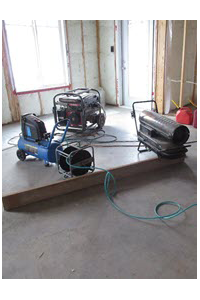
- Operating generator inside building led to high carbon monoxide levels. The worker was using the gas-powered generator indoors to power an air compressor for the air stapler he was using and for the electrical thermostat of a kerosene space heater. The worker had found the space heater in a storage locker. Doors and windows had been installed at the house, and the basement vapour barrier was complete. As a result, fresh air could not enter the space, and exhaust from the generator could not leave the space, allowing hazardous levels of carbon monoxide (CO) to accumulate. The worker was exposed to these high CO levels. It is believed he died from them the day before he was found.
Contributing factors
- Failure to identify hazards and implement controls.
- The employer did not conduct hazard identification and risk assessment, which would have identified the potential for harmful levels of CO to accumulate inside the workplace.
- Contrary to the manufacturer’s instructions, the worker was operating the generator indoors, with all doors and windows closed. Had the generator been operating outdoors, harmful levels of CO would not have accumulated in the basement nor risen by convection to the main floor. The employer did not ensure the worker was trained to operate the generator in accordance with the manufacturer’s instructions. The employer also did not implement alternatives to using the generator, such as having a temporary construction site power supply installed or operating other types of heating equipment or power supply from outside of the basement.
- The hazard of the potential consequences of working alone was also not identified. Had it been, and had an adequate risk assessment been conducted and control measures put in place, the employer could have set up a check-in system for the worker when he was working alone.
- Inadequate supervision. The employer did not make the worker aware of the hazards at the site, or put in place controls to reduce the related risks. In this regard, the employer did not provide the worker with adequate supervision during his assigned work activities.
- Cold weather. Cold weather resulted in a potentially uncomfortable working environment inside the house, with the danger of cold stress for the worker. Using a gas-powered generator to power the thermostat of a kerosene heater in the basement resulted in the accumulation of hazardous levels of CO.
- Working alone. The employer did not implement a check-in procedure for the worker to follow during or at the end of each shift to ensure the worker had not undergone an emergency event and needed help when working alone.
2021-04-22 20:42:33