
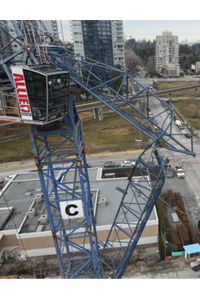
Tower crane jib partially collapsed, narrowly missing workers
Date of incident: January 2024
Notice of incident number: 2024115130002
Employer: Construction company
Incident summary
A crane operator at a highrise construction site was setting up for morning testing of a luffing tower crane, a crane in which the jib can be raised and lowered by the operator. While lowering the jib, the operator heard a loud bang. The crane shuddered to a stop. The crane swung to the right and then to the left, and then the jib partially collapsed into the worksite. Several workers narrowly missed being struck by the jib and by the hook block and load line attached to it that swung through the worksite during the collapse. No workers were injured.
Investigation conclusions
Cause
-
Assembly tie became entangled in connection pin.
- The assembly tie — a cable used to support the jib during assembly but that hangs slack during crane operation — was positioned below the connection pin that attaches two jib sections. While the jib was being lowered, the assembly tie became caught on the connection pin. The assembly tie should have been prevented from catching on the connection pin by an assembly tie support, but either the assembly tie support broke off or the assembly tie moved to the outside of the support.
- With the assembly tie caught on the pin while the jib was being lowered, the connections between the two sections of the jib closest to the tower bent and broke on one side because of the forced twisting of the jib. The twisting of the jib likely occurred as a result of one side of the jib being held at a fixed position (by being caught on the assembly tie), while the other side of the jib was free to move as the jib was being lowered.
Contributing factors
- Inadequate training. The employer did not provide the operator with adequate instruction; specifically, the employer did not provide the operator with two safe work procedures (SWPs) related to crane operation and with a specific orientation form for the crane involved in the incident. None of the operator’s training was documented, nor had the employer ensured that the trainer was qualified to train others. The employer did not demonstrate that it met the requirements of the Occupational Health and Safety Regulation in training the operator and did not ensure that the operator demonstrated competency
- Safe work procedures not followed. The employer had sufficient SWPs for the work being performed on the day of the incident. However, there is no indication that the employer had provided the operator with training on the overhead crane safety SWP and the erect and dismantle SWP. The overhead crane safety SWP was not fully complied with as the employer did not provide adequate orientation or training for the crane to its workers.
- Ineffective supervision. The employer did not ensure that the SWPs were followed or that the operator received sufficient training.
- Inadequate controls. Workers were exposed to a high risk of serious injury or death in the event of structural failure of the crane. The employer did not implement administrative controls, such as operator training, that could have effectively controlled this exposure. For the period between the assignment of the operator to the luffing tower crane and the date of the incident, regulatory requirements related to administrative controls for the safe operation of the crane were not met.
data-bs-keyboard="true">
2021-04-22 20:42:33