
Concrete pipe fell from gantry crane into shaft, narrowly missing workers
Date of incident: June 2024
Notice of incident number: 2024182130010
Employers: Three construction companies (one as prime contractor)
Incident summary
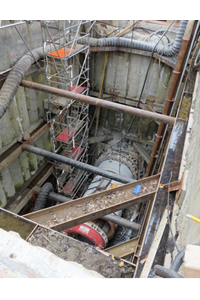
Workers at an infrastructure construction site were installing a 3 km (1.9 mi.) long sewer pipeline in an underground tunnel. A gantry crane was being used to lower a 17.4 metric ton (38,360 lb.) concrete sewer pipe into an excavated access shaft more than 10 m (33 ft.) deep. As the pipe neared the bottom of the shaft, the hoist line came off one of the crane’s two drums and the pipe dropped approximately 1 m (3 ft.) to the bottom. Although two workers were located near where the pipe landed, no one was injured.
Investigation conclusions
Cause
- Failure of electrical components led to crane dropping load. The gantry crane experienced two electrical failures, most likely due to the electrical components being worn. One failure allowed the hoist line to fully spool around one hoist’s drum; the other allowed the hoist line to fully unspool from the other hoist’s drum. Together, these failures resulted in the crane’s hoist line disconnecting from one of the hoist drums while the sewer pipe was being lowered into the shaft.
Contributing factors
- Failure to implement maintenance inspections of crane. The prime contractor, which owned the gantry crane, failed to implement a maintenance inspection schedule for the gantry crane that was consistent with the crane manufacturer’s recommendations. Because of the long operating shifts of the gantry crane, the crane should have been undergoing quarterly maintenance inspections. Instead, the gantry crane did not receive any maintenance inspections, regularly scheduled or otherwise, during its entire 19-month operational period at the worksite. Had regularly scheduled maintenance inspections of the gantry crane been occurring, it is likely that signs of wear of the electrical components would have been detected before the components failed, and the incident could therefore have been prevented.
- Failure to carry out effective pre-use inspection of crane. Pre-use inspections of the gantry crane according to the manufacturer’s instructions were not carried out. Specifically, on the day of the incident, a lower limit switch test was not conducted, as required by the crane’s operating manual and by the Occupational Health and Safety Regulation. Had the function test of the lower limit switch been completed that morning, workers would likely have discovered that the lower limit switch was not operating as it should. Operations of the crane would then have been halted, thereby preventing the incident from occurring.
- Inadequate information, instruction, training, and supervision. Although the three construction companies all provided workers with information, instruction, training, and supervision, they failed to ensure that the workers understood how to check the functionality of the crane’s lower limit switch or knew the minimum number of hoist line wraps required. They also failed to ensure that the crane’s operating manual, in particular information about the maintenance interval schedule for the crane, was read, understood, and implemented by the workers responsible for the crane’s maintenance and safe operation.
2021-04-22 20:42:33