
Worker seriously injured when pinned between two forklifts
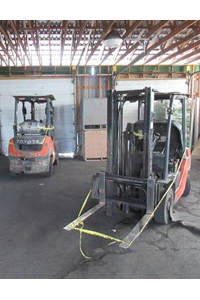
Date of incident: June 2025
Notice of incident number: 2025158820011
Employer: Trucking company
Incident summary
A worker in a warehouse was performing a repair on a stationary lift truck (forklift) that had broken down. At the same time, another worker was unloading a trailer using a second forklift. During the unloading process, the operating forklift reversed and struck the worker performing the repair, pinning the worker between the two forklifts. The worker sustained serious injuries.
Investigation conclusions
Cause
- Worker pinned between two forklifts in congested work area. The operating forklift was backing up in a congested, poorly lit work area near the broken-down forklift that was undergoing maintenance when the forklift inadvertently struck the worker.
Contributing factors
- Lack of effective work procedures. The employer did not have documented safe work procedures, risk assessments, or equipment inspection protocols. There was no system for tracking or addressing identified equipment deficiencies.
- Deficient equipment maintenance. Both forklifts had unresolved mechanical issues. The throttle pedal on the broken-down forklift had a known defect for over a month. Backup alarms and mirrors were missing or obstructed on both forklifts, resulting in limited visibility, especially in congested areas with low lighting. The equipment was not well maintained.
- Time pressure and operational constraints. Workers were under pressure to meet delivery deadlines. The use of two forklifts in a congested space was a deviation from standard practice driven by workload demands.
- Lack of training or effective health and safety program. The employer failed to implement a health and safety program as required by the Occupational Health and Safety Regulation. New workers were not provided with new worker orientation or training specific to their work tasks, and workers operated mobile equipment without formal instruction. No training records were maintained, and there was no evidence of competency assessments or documented safety procedures. The absence of these critical elements of a health and safety program reflects a systemic failure to ensure worker safety and regulatory compliance.
- Inadequate supervision. Workers at the warehouse worked unsupervised for extended periods, and no working-alone procedures were in place. The employer failed to ensure that the warehouse had adequate lighting in the area where mobile equipment regularly operated. The employer further failed to ensure that forklift operators were properly trained to operate the mobile equipment or that they completed pre-use inspections.
2021-04-22 20:42:33