
Worker overcome by toxic vapours while waterproofing concrete pit
Date of incident: April 2024
Notice of incident number: 2024203070002
Employers: Non-market housing developer; waterproofing firm
Incident summary
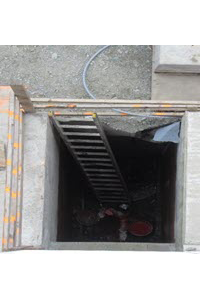
At a site where an apartment building was being built, a worker (the labourer) was applying waterproofing primer to the walls of a narrow concrete pit. The pit was 4.3 m (14 ft.) deep. The labourer had used a portion of an extension ladder to enter it. After a time, the labourer was overcome by toxic vapours from the primer. The construction safety officer (CSO) for the site was notified. The CSO climbed down into the pit to rescue the worker and was also overcome by the vapours. When firefighters arrived, the workers received assistance to climb out of the pit. Both received medical attention.
Investigation conclusions
Cause
- Exposure to adverse atmospheric conditions in confined space. Toxic vapours from the primer accumulated inside the confined space, which caused the labourer and the CSO to become incapacitated.
Contributing factors
- Insufficient hazard assessment and safe work procedures. The developer failed to identify the pit as a confined space. The hazards and risks associated with working in the confined space were not documented. The work involved being 4.3 m (14 ft.) down in a confined space and using a hazardous product that released toxic and highly flammable vapours without proper PPE, standby rescue personnel, rescue equipment, or other required controls. There were no written safe work procedures for the confined space entry or for applying the primer. In addition, no mechanical ventilation was used in the pit, and natural ventilation was minimal or non-existent due to the narrow confines and depth of the space.
- Inadequate training. The waterproofing firm did not ensure that its workers received specific confined space training or that they were made aware of the contents of the safety data sheet (SDS) for the controlled product applied to the walls of the pit. The respirator used in the pit was not suitable for the atmosphere and had not been fit-tested.
- Inadequate supervision. Direct in-person supervision was not being provided at the workplace at the time of the incident, and the developer had not ensured that a field-level risk assessment (FLRA) and job hazard analysis (JHA) were completed before the primer application began. The developer did not identify the pit as a confined space. As well, an unsuitable method (part of an extension ladder) was used to access the pit.
- Inadequate coordination at multiple-employer workplace. The prime contractor for the project (the developer) did not ensure that health and safety was coordinated among all employers at the workplace, and failed to maintain a system that would ensure compliance with Part 2 of the Workers Compensation Act and with the Occupational Health and Safety Regulation at the workplace. The prime contractor also did not identify the hazard of highly flammable and toxic vapours from the primer or ensure controls were put in place to protect workers prior to allowing work to proceed in the pit.