
Worker fatally struck by flytable that fell from overhead
Date of incident: February 2024
Notice of incident number: 2024178050003
Employers: Construction management and general contracting company (prime contractor); concrete forming company; engineering firm
Incident summary
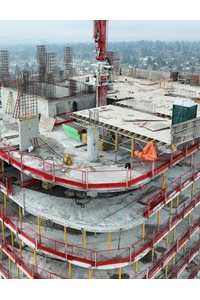
At a highrise construction site, workers were hoisting a flytable — a large piece of formwork (mould for concrete) that was 9.6 m (31 ft. 6 in.) long and 6.0 m (19 ft. 8 in.) wide — from the 26th floor to the 27th floor using a tower crane. Several workers were slowly pushing the flytable, which was rigged to the crane, out of one end of the building when the flytable suddenly accelerated out of the side of the building. The flytable fell to the ground and struck a worker, who sustained fatal injuries.
Investigation conclusions
Cause
- Lifting points failed and flytable fell and struck worker. The incident was the result of several critical safety failures. Workers lost control of the flytable as it shot out of the building. The flytable was connected to the tower crane by chain slings attached to lifting points on the flytable in three locations: two points at the front of the flytable and one near the rear. The rear lifting point detached, followed by the front lifting points giving way, and the flytable fell to the ground.
Contributing factors
- Inadequate ground control zones. Neither the employer completing the work at the time of the incident (the concrete forming company) nor the prime contractor provided any documentation regarding ground control zones (designated areas that workers and other persons should not enter). CCTV footage of the worksite revealed that safety protocols were not followed, with workers often under suspended loads and entering areas that should have been designated ground control zones, with no effective controls in place. There was a lack of clarity about who among the prime contractor, the concrete forming company, and other subcontractors on site was responsible for the establishment and monitoring of ground control zones. This ambiguity contributed significantly to the incident, as no single employer took responsibility, leading to ineffective management of the health and safety of workers on site.
- Ineffective design of rear connector. The front lifting points used hooks with safety latches, while the rear lifting point featured a hybrid connector assembly that was not approved by the manufacturer or a professional engineer. The rear connector was secured to a lifting point pin on the flytable. The motion and forces applied to the rear connector during the incident enabled the rear lifting point pin to shift up and over the safety flanges on the connector and then disconnect completely from the connector. The safety flanges were not an effective means of retaining the pin and preventing an unintentional disconnection.
- Concrete slab edge missing curb. The right rear flytable wheel was close to the edge of the concrete slab (the floor of the 26th level) before the incident, and a curb would likely have prevented the wheel from running off the slab edge. The absence of an effective curb near the slab edge likely contributed to the incident.
- Brake line ineffective. One end of the brake line (a rope used to control the flytable during its movement and stop it if necessary) was attached to the rear cross brace of the flytable with a knot, and the other end was wrapped around a D-ring approximately 7 m (23 ft.) away. The brake line did not stop the flytable’s rapid acceleration out of the building. The evidence suggests that either the brake line was detached from the flytable too early or that the knot securing it came undone during the incident. In addition, the cross brace was not structurally adequate; even if the brake line had been securely attached at the time of the incident, it is likely the cross brace would have failed, rendering the brake line ineffective.
- Failure to identify critical lift. Moving the flytables is considered a critical lift because the length of the load chain alters during the lifting process. Neither the concrete forming company nor the prime contractor identified the work activity on the day of the incident as a critical lift. The prime contractor did not ensure that the concrete forming company executed the requirements for a critical lift, including preparing a written lift plan. A written lift plan would have highlighted the need for and the position of signallers (spotters).
-
Lack of hazard identification and risk assessment.
- For every critical lift, a pre-job meeting must occur to discuss the lifting procedure with all workers involved in the lift. However, since the work activity had not been identified as a critical lift, no such meeting took place on the day of the incident. Had such a meeting been conducted, workers might have identified that there was no written procedure for moving asymmetrical corner flytables such as the one involved in the incident and that there was a risk of a flytable wheel running off the slab edge when moving corner flytables.
- Neither the concrete forming company nor the prime contractor conducted effective workplace inspections to identify the hazards associated with flytables, chain hoists, ground control, or spotters while workers were moving flytables at the worksite. This oversight led to unsafe conditions, resulting in the incident.
- Lack of safe work procedures. Although a safe job procedure for conventional flytables existed, the concrete forming company did not have procedures or a written critical lift plan for handling corner flytables. In addition, instructions from the engineering firm that designed the flytables did not include procedures for moving corner flytables, and no steps were taken by that firm or the concrete forming company to ensure that these procedures were created. Had these procedures been developed and implemented, the risk of the rear flytable wheels running off the slab edge could have been controlled. Further, there were no manufacturer’s instructions for the three lifting point system that was being used at the time of the incident, and no safe work procedures existed to ensure that the flytable’s brake line was properly connected.
-
Inadequate training, instruction, and supervision.
- Workers were assigned to perform spotting and ground control duties without proper training or instruction. Workers were not provided with instructions about the relationship between the size of the ground control zone and the height of a building, or with any plans pertaining to the set-up of ground control zones. There was no system or process of supervision in place to provide instruction or direction for this work activity.
- There was no system for supervision or communication between the supervisor and any workers other than the riggers and crane operator. Workers did not receive adequate training, instruction, or supervision with regard to moving flytables or critical lift procedures. Workers on the ground were expected to monitor flytable movements without adequate supervision or processes in place.
-
Prime contractor did not fulfill responsibilities.
- The prime contractor did not ensure that the hazards were identified or that the safety measures for critical lifts and overhead work were coordinated, exposing workers to serious risks. It failed to ensure that adequate planning, coordination, hazard identification, risk assessment, training, and supervision occurred for the critical lift and overhead work on the day of the incident.
- The prime contractor also failed to review policies and procedures as required by the Occupational Health and Safety Regulation. Specifically, it did not review the implementation of procedures for spotters and ground control zones during the hoisting and repositioning of flytables, leading to the development of unsafe conditions. The inadequate fulfillment of prime contractor responsibilities was a key contributing factor in the incident.
Other health and safety issues
- Hybrid rear lifting point connector. The connector to the rear lifting point pin was a hybrid of a newer and an older model, which required approval by a professional engineer or the manufacturer to comply with the Regulation and industry standards. No such approvals had been obtained, but although the hybrid rear connector did not comply with the Regulation, it did not structurally differ from a compliant version. Therefore, the hybrid nature of the connector was likely not a contributing factor in the incident.
- Damage to the rear lifting point connector. There was significant damage to the bottom part of the rear connector, particularly at the front. This damage was likely sustained prior to the incident as a result of hammering by workers. Although the damage likely did not contribute to the incident, the connector ought to have been removed from service until repaired.
- Flytable drawings missing details. The flytable drawings were missing crucial details, such as the flytable weight and the rear lifting point position. However, these omissions did not affect the flytable’s rapid acceleration out of the building. The flytable had been moved successfully 12 times prior to the incident, indicating that weight and lifting point location issues would have surfaced earlier.
- Lack of adherence to manufacturer’s instructions. The process for moving the flytable during the incident required workers to push it out of the building, which deviated from the manufacturer’s instructions, which required the use of a compensator (a component of the rigging system, also known as a chain positioning unit) to pull the flytable out of the building.
- Safe job procedures missing information. The safe job procedures for rolling the flytable out of the building were missing important information, such as not specifying how to attach the connectors to the lifting points and not explaining the need to install a guidance shoe at the slab edge. The safe job procedures did not indicate that the flytable drawings and manufacturer’s instructions must be followed along with the procedure. However, the missing information in the safe job procedures was not a contributing factor in the incident.
- Condition of compensator. The compensator being used during the incident had several issues, including that it had exceeded its expected service life, the condition of the holding brake was unacceptable based on the manufacturer’s specifications, and the gear box was improperly inspected and maintained. However, there was no evidence to indicate that the compensator influenced the flytable’s sudden acceleration out of the building.